- Published
- Updated
- Reading time
- 5 min
- Topic
- AI Marketing
On this page
- 01What Is AI Marketing Strategy, Really?
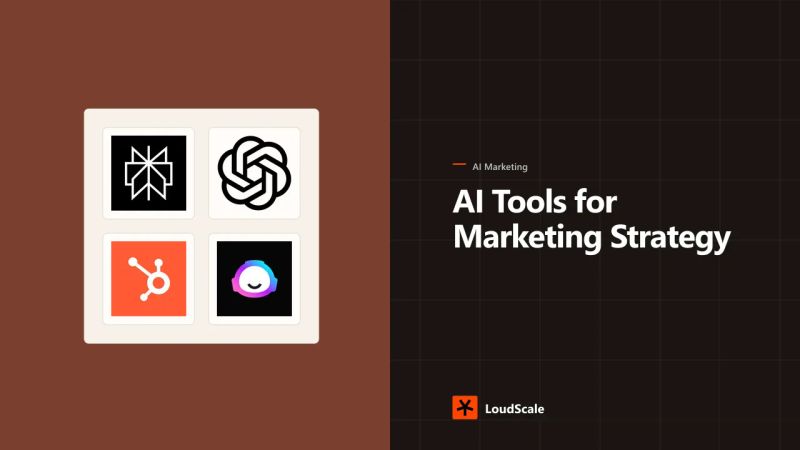
- 02Top AI Marketing Strategy Tools in 2026 (Quick Answer)
- 03AI Tools for Marketing Research
- 041. Perplexity Pro for source-backed answers
- 052. ChatGPT (Plus or Team) for synthesis
- 063. HubSpot AI Search Grader
- 07AI Tools for Audience Insights
- 084. 6sense Revenue AI for B2B
- 095. SparkToro, Audiense, and social-listening AI
- 10AI Tools for Competitive Analysis
- 116. Crayon and Kompyte
- 127. ChatGPT Deep Research mode
- 13AI Tools for Campaign Planning and Content
- 148. HubSpot Campaign Assistant (free)
- 159. Jasper for brand-controlled content
- 1610. HubSpot Breeze Agents (2026 release)
- 17AI Tools for Forecasting and Measurement
- 1811. Google Analytics 4 + AI insights
- 1912. Adverity or Improvado for cross-channel reporting
- 2013. Mutiny and Persado for on-page personalization
- 21Comparison Table: Best AI Tools for Marketing Strategy in 2026
- 22A 2026 AI Marketing Strategy Workflow
- 23A Word of Caution From the 2026 Data
- 24Frequently Asked Questions
- 25What are the best AI tools for marketing strategy in 2026?
- 26How much do AI marketing strategy tools cost in 2026?
- 27Can AI replace a marketing strategist?
- 28What’s the difference between AI marketing tools and AI marketing strategy tools?
- 29How do I pick the right AI strategy tool for my business?
- 30Sources
AI can assist with campaign research and planning, but the useful measure is total time to a well-supported plan, including verification and review.
That’s the real story behind the 2026 numbers. According to HubSpot’s 2026 State of Marketing Report, 80% of marketers now use AI for content creation and 75% for media production. And 86% say AI saves them an hour or more every day. We’re not in the “should I use AI?” phase anymore. We’re in the “how do I use it without sounding like a robot?” phase.
This guide maps tools to strategy tasks, compares workflow considerations, and provides a process you can adapt.
What Is AI Marketing Strategy, Really?
AI marketing strategy is the practice of using artificial intelligence tools to research, plan, forecast, and optimize marketing campaigns faster and more accurately than a human team could alone.
That’s the textbook line. Here’s the honest one: it’s a way to spend less time gathering and processing information, and more time making the calls that actually require taste.
In practice, an AI marketing strategy includes:
- Research: scanning thousands of articles, reviews, and social posts in minutes
- Audience insights: clustering customers by behavior, not just demographics
- Competitive analysis: tracking rivals’ moves across the web
- Planning: turning research into briefs, channel mixes, and budgets
- Forecasting: predicting campaign performance before you spend a dollar
Salesforce’s 10th Edition State of Marketing report (Feb 2026) found that 75% of marketers have now adopted AI, and 88% are actively optimizing for AI-generated search answers. AI isn’t an experiment in 2026. It’s the planning surface.
Top AI Marketing Strategy Tools in 2026 (Quick Answer)
Here is a shortlist organized by use case. Validate each candidate against your actual data and workflow.
| Tool | Best for | Starting price (2026) | Output you get |
|---|---|---|---|
| HubSpot Breeze | All-in-one CRM + AI agents | Free; pay per resolution | Strategy briefs, content, lead scoring |
| Jasper | On-brand content at scale | $59/mo (annual) | Long-form content, campaigns |
| ChatGPT (OpenAI) | Research, ideation, drafts | $20/mo (Plus) | Research summaries, strategy memos |
| Perplexity Pro | Cited market research | $20/mo | Source-backed answers |
| 6sense Revenue AI | B2B intent + account targeting | Custom | Buying intent signals |
| Synthesia | Strategy videos, training | $29/mo (Starter) | AI avatar videos |
| Howler AI | PR and journalist targeting | ~$8,000/mo (per HubSpot) | Pitched media lists |
| HubSpot Campaign Assistant | Campaign copy in seconds | Free | Email, ad, landing copy |
AI Tools for Marketing Research
The first half of any strategy is research.
1. Perplexity Pro for source-backed answers
You ask a question, it gives you a clean answer with cited sources inline.
- “What are the top 5 pain points SaaS CMOs mention on Reddit in 2026?”
- “Summarize the last 6 months of [competitor]‘s product launches with sources.”
The cited sources are critical because they let you verify instead of trusting an LLM.
2. ChatGPT (Plus or Team) for synthesis
Sam Altman said in late 2024 that ChatGPT had 100 million weekly active users. Marketing is the heaviest-adopting industry at 77%, per the same data.
A possible ChatGPT workflow is to extract objections and recurring themes from customer interviews. Check each theme against the transcript and protect confidential information before using the output in a strategy.
3. HubSpot AI Search Grader
If you care about being mentioned in AI search answers (and you should - half of all Google searches now show AI summaries), HubSpot’s free AI Search Grader tells you how often ChatGPT, Gemini, and Claude mention your brand versus your competitors.
AI Tools for Audience Insights
Audience work is where most strategy documents fall apart. AI tools can change that.
4. 6sense Revenue AI for B2B
6sense is an option for B2B research. It uses AI to analyze billions of intent signals (research, content consumed, keywords searched) and tells you which accounts are actually in-market. This replaces the spammy “spray and pray” lead list with a small list of accounts that look like they’re shopping right now.
5. SparkToro, Audiense, and social-listening AI
For B2C, SparkToro gives you an audience profile by analyzing who follows and engages with any account. Brand24 (starts around $69/mo) does real-time social listening with AI sentiment scoring.
Forrester’s 2026 CMO Predictions (October 2025) noted that high performers are 2.8x more likely to use unified customer data to create relevant experiences. Translation: if you don’t have AI helping you synthesize audience signals, you’re guessing.
AI Tools for Competitive Analysis
You can’t plan a campaign if you don’t know what your rivals are doing.
6. Crayon and Kompyte
Crayon and Kompyte (now part of Semrush) both watch competitor websites, pricing pages, ad copy, and content changes with AI. They ping you when a competitor makes a move, so you’re not the last to know.
7. ChatGPT Deep Research mode
ChatGPT Deep Research can help prepare a cited competitive brief. Verify the sources, coverage, and claims before using it to make decisions; output length and completion time vary.
Quick stat to remember: In 2026, Deloitte predicts that gen AI inside existing search engines will be 300% more common than standalone gen AI tools. So your “AI strategy tool” might end up being the search bar you already use.
AI Tools for Campaign Planning and Content
Planning and content get most of the attention.
8. HubSpot Campaign Assistant (free)
Campaign Assistant is free, lives inside HubSpot, and generates landing pages, marketing emails, and ad copy for Google, Facebook, LinkedIn, and Instagram from a single brief. The free tier alone replaces $50-200/mo in copy tools for small teams.
9. Jasper for brand-controlled content
Jasper sits at $59/mo (annual) or $69/mo (monthly) on its Pro plan, with custom enterprise pricing above that. Where Jasper wins is brand voice training. You upload your best-performing content and Jasper’s Brand Voice and Style Guide features try to match it. The Business plan adds unlimited Brand Voices and Jasper Grid for scaled content execution.
10. HubSpot Breeze Agents (2026 release)
Breeze is the most ambitious 2026 release in this space. It’s not a single tool - it’s a set of AI agents that live inside your CRM. The pricing is usage-based on outcomes:
- Customer agent: $0.50 per resolved conversation
- Prospecting agent: $1.00 per qualified lead
- Data agent: $0.10 per answer
HubSpot claims customer agent resolves up to 70% of conversations automatically, and prospecting agent drives 2x higher response rates. Real numbers from a real customer (Sandler): 8,000 new website visitors and 12 new account conversions in weeks of using AEO tools.
AI Tools for Forecasting and Measurement
The unsexy half of strategy. The part everyone skips until launch day.
11. Google Analytics 4 + AI insights
GA4 has shipped natural-language insight generation. You can ask it “what drove the spike in conversions last Tuesday?” and it walks you through it. It’s basic, but it’s free and gets smarter each quarter.
12. Adverity or Improvado for cross-channel reporting
Adverity starts at $500/mo and pulls data from every channel you use into one dashboard. Its AI flags anomalies (“your LinkedIn CPL jumped 40% this week”) before you notice them in a slide deck.
13. Mutiny and Persado for on-page personalization
If your strategy includes personalizing the website experience, Mutiny and Persado both use AI to swap headlines, CTAs, and body copy based on who’s visiting. Salesforce’s 2026 report found that 78% of marketers say they need more personalized content than they can produce, and 75% are now using AI to close that gap.
Comparison Table: Best AI Tools for Marketing Strategy in 2026
| Use case | Tool | Price (2026) | Best for | Output format |
|---|---|---|---|---|
| Research | Perplexity Pro | $20/mo | Cited, source-backed answers | Brief with links |
| Research | ChatGPT Plus | $20/mo | Synthesis, ideation, drafts | Memos, outlines |
| Audience insights | 6sense | Custom | B2B account targeting | Account lists + scores |
| Audience insights | Brand24 | From $69/mo | Sentiment + social listening | Dashboards, alerts |
| Competitive intel | Crayon / Kompyte | Custom | Tracking competitor moves | Change alerts, briefs |
| Competitive intel | ChatGPT Deep Research | $20/mo (Plus) | Long-form competitive brief | 15-20 page report |
| Planning | HubSpot Campaign Assistant | Free | Campaign copy, emails, ads | Copy + landing pages |
| Content | Jasper | $59/mo (annual) | Brand-aligned long-form | Articles, campaigns |
| Content | HubSpot Breeze | Free + usage fees | All-in-one agentic platform | Strategy + execution |
| PR | Howler AI | ~$8,000/mo (per HubSpot) | Journalist targeting | Pitches + media lists |
| Forecasting | GA4 AI insights | Free | Anomaly detection | Plain-English reports |
| Forecasting | Adverity | From $500/mo | Cross-channel dashboards | Unified dashboards |
| Personalization | Mutiny | Custom | On-site personalization | Variant pages |
| Video | Synthesia | From $29/mo | Strategy videos, training | AI avatar videos |
| Strategy ops | Publicis + LiveRamp (acquired May 2026) | Enterprise | Data + agentic AI orchestration | Identity resolution |
A 2026 AI Marketing Strategy Workflow
Here is a suggested workflow to adapt. The time allocations below are planning estimates, not measured client results.
- Day 1 - Landscape scan. Identify relevant trends, competitors, and audience segments with a research tool, then check the underlying sources.
- Day 1 - Audience clustering (1 hour). Drop a sample of customer reviews and survey responses into ChatGPT and ask it to cluster pain points, jobs-to-be-done, and emotional triggers. Clean it up.
- Day 2 - Competitive brief (2 hours). The two outputs get merged into a 10-page brief.
- Day 3 - Strategy doc and channel mix (3 hours). Use HubSpot Campaign Assistant to draft the campaign copy outline. Write the strategy doc in Google Docs, then use ChatGPT to pressure-test the recommendations (“What am I missing?”). It catches blind spots.
- Day 4 - Build the measurement plan (1 hour). Set up GA4 AI insights, an Adverity dashboard, and a weekly check-in alert. Forecasting is just measurement done in advance.
- Day 5 - Stakeholder deck (2 hours). Synthesia generates a 2-minute avatar video summarizing the strategy for the executive team. It cuts the kickoff meeting in half because everyone watches before the call.
- Ongoing - Weekly optimization. Breeze prospecting agent monitors in-market accounts.
Total time: about 10 hours of actual work, spread across a week. Three years ago this would have been a two-week project with a team of three.
A Word of Caution From the 2026 Data
The same Salesforce report that showed 75% of marketers have adopted AI also found that 84% still run generic campaigns. And 69% struggle to respond to customers promptly.
The tools aren’t the bottleneck. Data quality and strategy clarity are. As Bobby Jania, Salesforce’s Agentforce Marketing CMO, put it: “We are using the most powerful technology in history to send more one-way spam, faster.”
Don’t be that team. The AI is the easy part. Knowing what to ask it is the hard part.
Frequently Asked Questions
What are the best AI tools for marketing strategy in 2026?
The strongest 2026 stack combines a research tool (Perplexity or ChatGPT), an audience intelligence tool (6sense for B2B, Brand24 for B2C), an all-in-one execution platform (HubSpot Breeze), and a content tool (Jasper). This covers research, planning, execution, and measurement.
How much do AI marketing strategy tools cost in 2026?
You can start for free. HubSpot Breeze Assistant, HubSpot Campaign Assistant, ChatGPT (free tier), Perplexity (free tier), and GA4 are all $0. A serious 2026 stack costs $100-500/mo for a small team. Enterprise tools like 6sense, Crayon, and Howler AI run into the thousands per month.
Can AI replace a marketing strategist?
No. AI is excellent at research, drafting, and pattern recognition. It’s bad at taste, judgment, and stakeholder management. The 2026 data shows AI is the baseline - the gap is in how well you use it, not whether you use it.
What’s the difference between AI marketing tools and AI marketing strategy tools?
AI marketing tools cover execution: copywriting, email sends, ad bidding. AI marketing strategy tools cover the up-front work: research, audience clustering, competitive analysis, channel mix modeling, and forecasting. You need both, but this article is about the strategy side.
How do I pick the right AI strategy tool for my business?
Start with the bottleneck. If you don’t know your audience, start with Perplexity and 6sense. If you don’t know what to write, start with Jasper. If you don’t know how to measure, start with GA4. Don’t buy all 13 at once.
Sources
- HubSpot 2026 State of Marketing Report
- Salesforce 10th Edition State of Marketing Report (Feb 2026)
- Deloitte TMT Predictions 2026 (Nov 2025)
- Forrester Predictions 2026: CMOs Hunker Down
- Forrester: Marketers Are In Their AI Era (Sept 2025)
- HubSpot: 36 AI Marketing Tools (Mar 2026)
- HubSpot Breeze AI product page
- Jasper Pricing Page
- Synthesia Pricing Page
- ChatGPT User Statistics - SEO.AI
- Forrester: Publicis Acquires LiveRamp (May 2026)
Free tools
All tools- Website Growth GraderFlagship free growth grade score before email.
- SEO Checker40+ live HTML checks on any public URL.
- AI Visibility ReadinessAnswer-engine readiness and extractability.
Diagnostics show a useful score before email. Explore LoudScale services when you want a full plan and implementation.

Written by the team
LoudScale Team
Growth Marketing Specialists
The LoudScale team shares practical strategies, research analysis, and evidence-backed guidance across search and AI visibility, content authority, B2B lead generation, lifecycle systems, analytics, and responsible AI.