TL;DR
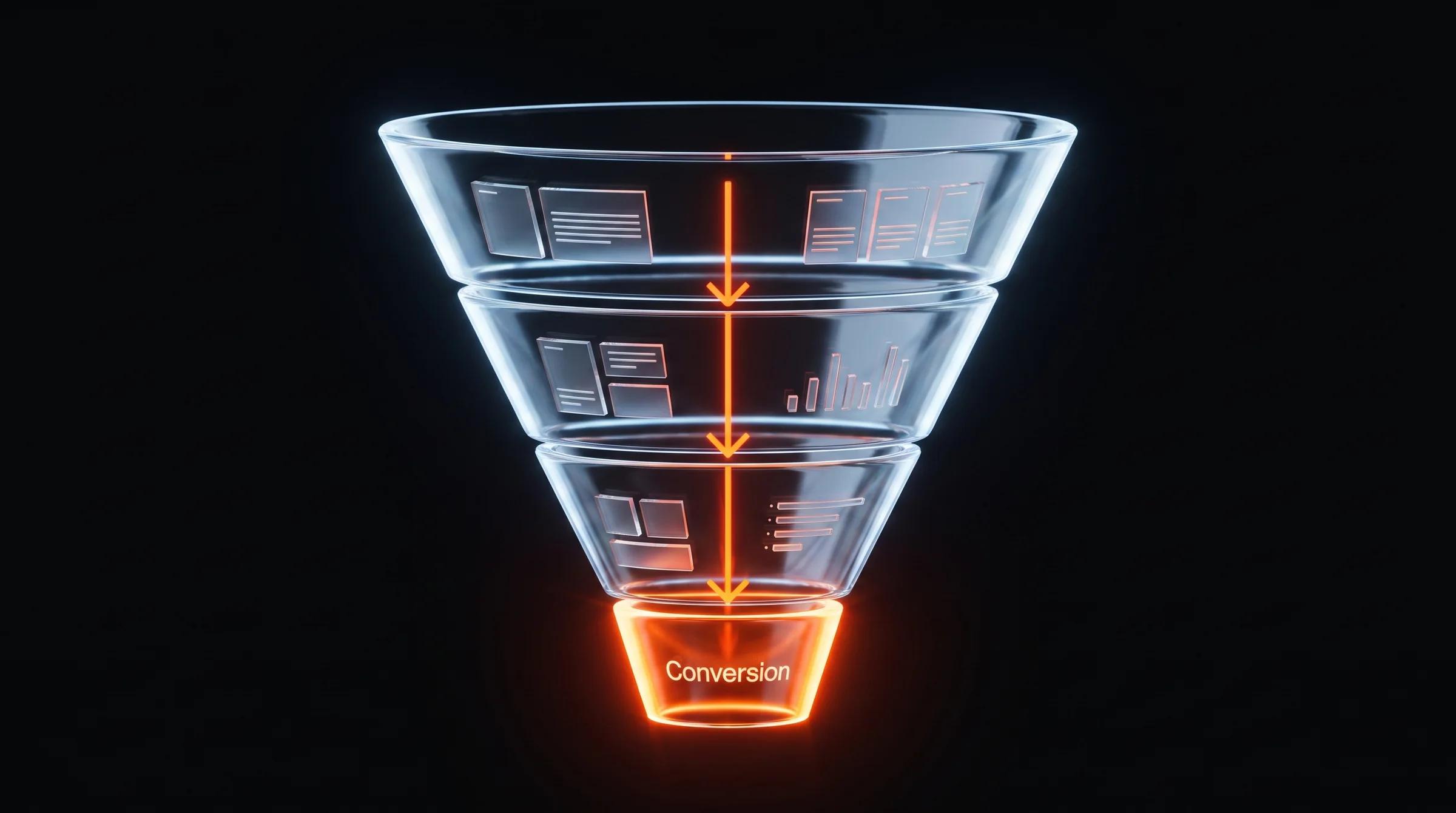
- 86% of B2B purchases stall during the buying process - and the middle of the funnel is where most of them die (Forrester, 2024).
- The average B2B purchase in 2026 now involves 13 internal stakeholders and 9 external influencers - 22 people total - per Forrester’s State of Business Buying, 2026.
- 67% of B2B buyers now prefer a rep-free experience, meaning your content is doing the work a salesperson used to do (Gartner, 2026).
- This guide introduces the Funnel Leak Audit - a diagnostic framework to pinpoint which stage is costing you pipeline - plus a Content-to-Committee Map that matches assets to specific buyer roles, not just funnel stages.
Your Funnel Is Leaking. It’s Probably the Middle.
I spent the first half of 2025 convinced our content strategy was working. Traffic was up. Whitepaper downloads looked healthy. The blog had a pulse.
Then I traced the pipeline. Leads entered. Few emerged. Deals that should have closed just… sat there. When I audited our content library, the problem was obvious. We had 63% awareness content and 9% consideration content. Our funnel was shaped like a funnel - but our content allocation was shaped like a marshmallow.
I ran a content audit for a B2B SaaS client last quarter. Their library broke down like this:
| Funnel Stage | Content Library Share | Where Deals Actually Stalled | Recommended Allocation |
|---|---|---|---|
| Top (Awareness) | 58% | 12% of stalled deals | 30-35% |
| Middle (Consideration) | 14% | 53% of stalled deals | 40-45% |
| Bottom (Decision) | 28% | 35% of stalled deals | 25-30% |
The middle desert isn’t a metaphor. It’s a measurable content deficit that directly correlates to pipeline stagnation. And 2026’s buying environment has made the middle even more treacherous.
The 2026 B2B Buying Reality Makes the Funnel Messier - Not Obsolete
Before I get into each stage, here’s what makes today’s funnel fundamentally different from the neat TOFU-MOFU-BOFU diagrams you learned five years ago.
Buying groups are massive. Forrester’s 2026 State of Business Buying report found the typical purchase now involves 13 internal stakeholders plus 9 external influencers. That’s 22 people. They’re not all at the same funnel stage. Your champion is ready to sign while the CFO hasn’t heard of your company. One piece of misaligned content - say, a case study sent to procurement that doesn’t address compliance - can reset an entire deal.
Buyers are pre-shortlisting you. 6sense’s 2025 Buyer Experience Report found that 94% of buying groups rank their preferred vendors before making contact with any sales rep. The vendor ranked first wins about 80% of the time. If your content didn’t get you onto that shortlist before anyone reached out, you probably already lost.
GenAI is changing how buyers research - but not their need for validation. Forrester reports that genAI searches are now the starting point for most B2B purchases. But only 36% of buyers felt more confident in their decisions because of AI. 20% felt less confident due to inaccurate information. Buyers are compensating by expanding their buying networks and seeking validation from trusted human sources - which makes your middle-funnel content more critical, not less.
Buyers prefer going rep-free. Gartner’s 2026 survey found 67% of B2B buyers now prefer a rep-free buying experience - up from 61% in 2025. Your content isn’t just supporting sales. It is the sales experience for two-thirds of your potential buyers.
“The brands that win are those brave enough to challenge conventional wisdom with research-backed insights leaders can trust and act on. The most effective thought leadership supports decision-making with memorable mental models and frameworks.” - Ty Heath, Director of Market Engagement, The B2B Institute at LinkedIn (CMI, 2026)
The Funnel Leak Audit: Diagnose Before You Produce
Most teams I work with jump straight to “we need more content.” That’s like prescribing medication without a diagnosis. Here’s the framework I use with every client:
- Pull your stage-to-stage conversion rates. Visitor → known lead. Known lead → sales-qualified opportunity. SQL → closed revenue. Get all three numbers. If you don’t have them, your first problem isn’t content - it’s measurement.
- Identify the steepest drop-off. If 6% of visitors convert to leads but 35% of those leads close, your leak is at the top. If you’re converting visitors but nothing becomes pipeline, you’ve got a middle desert.
- Tag every content asset by funnel stage - ruthlessly. That “thought leadership” report you labeled MOFU? If it doesn’t help someone evaluate whether you’re the right solution, it’s awareness content in disguise. The CMI 2026 research found that 40% of B2B marketers say creating content that prompts a desired action is their top challenge. Honest content tagging is where that fix starts.
- Compare your ratio to the problem. If your steepest drop is in the middle but your middle-funnel content is 15% of your library, you’ve found your bottleneck. Stop writing blog posts. Start filling that gap.
This audit takes about two hours. It’ll save you months of producing content that doesn’t address the real leak.
Stage 1: Top of Funnel - Earn the Right to Be Remembered
Top-of-funnel content exists to put you on the shortlist before the buyer starts actively evaluating. Not to generate leads. To generate memory.
The Gartner data tells us 67% of buyers want rep-free experiences. The 6sense data tells us 94% rank vendors before outreach. This means your TOFU content is doing the work of the first three sales calls.
What works in 2026:
-
Original research with a point of view. The CMI research shows 65% of effective teams credit content relevance and quality as their top driver of results. A data-backed perspective that challenges convention will outrank a “7 trends” listicle every time. Buyers share frameworks, not summaries.
-
Problem-education over product introduction. Someone searching “why does our CRM data keep breaking” doesn’t want to hear about your integration platform yet. They want to understand their problem. Meet them there first.
-
LinkedIn thought leadership with employee participation. CMI found that 96% of B2B marketers create thought leadership, but only 18% have substantial employee participation. The brands winning TOFU are putting actual practitioners out front, not just branded accounts.
What doesn’t work: Gating awareness content. If a buyer at the awareness stage hits a form wall, they’ll leave. The to-gate-or-not-to-gate question has a clear answer at this stage: don’t.
Stage 2: Middle of Funnel - Where $4.3 Trillion in Pipeline Goes to Die
The middle is where most funnel guides offer a paragraph and move on. It’s also where 86% of B2B purchases stall, according to Forrester. These two facts are related.
Middle-of-funnel content helps a prospect evaluate - not just learn about your category, but judge whether you specifically are the right choice. In 2026, this content has to work for all 22 people in the buying network, not just the champion who found you.
What the best MOFU content looks like right now:
-
Honest comparison and evaluation guides. Not gladiator-match “us vs. them.” Real trade-off analysis. “When to choose a platform like ours vs. building in-house” signals confidence. It also answers a question your buyer’s technical evaluator is already asking.
-
Technical deep-dives for the skeptic. Forrester found that integration capabilities are a top-three buying criterion for 77% of buyers (Demandbase, 2025). If your architecture documentation is a PDF buried in a support portal, you’re losing deals in the evaluation stage.
-
ROI frameworks with specific numbers. The CFO - who’s now involved in 79% of purchases (TrustRadius, 2024) - doesn’t care about feature parity. They care about months to payback. Give them a calculator, not a brochure.
-
Role-specific case studies. The dynamic here: a generic case study validates nothing. A case study that mirrors the prospect’s industry, company size, and role transforms from “nice to have” to “internal selling tool.” Your champion will forward it to their VP. That’s the test.
-
Trial and sandbox content. Forrester’s 2026 report found that 60% of buyers now use trials before committing, and 78% do so for purchases over $10 million. Your trial onboarding content - setup guides, success metrics templates, architecture walkthroughs - is middle-funnel content, not post-sale content.
The middle-funnel test I use: “Can this asset be forwarded to a skeptical stakeholder and close their specific objection without you in the room?” If the answer is no, it’s not middle-funnel content.
The Content-to-Committee Map
This is the framework that changed how I plan content. Map assets to specific committee members - not just funnel stages.
| Stakeholder | Core Question | Best Content Type | Funnel Stage |
|---|---|---|---|
| Champion / End User | ”Will this make my job easier?” | Product walkthroughs, peer comparison guides, community content | MOFU |
| Technical Evaluator | ”Will this work in our environment?” | Integration docs, API references, architecture diagrams, sandbox access | MOFU / BOFU |
| Department Head | ”Will my team hit our KPIs?” | ROI calculators, industry-matched case studies, adoption playbooks | MOFU |
| CFO / Finance | ”What’s the payback period and risk?” | TCO comparisons, pricing transparency, implementation timelines | BOFU |
| Procurement / Legal | ”Are we compliant and protected?” | Security certifications, SLA documentation, data processing agreements | BOFU |
Watch Out: If your sales team sends the same one-off emails answering procurement or technical evaluator questions across multiple deals, every repeated email is a missing content asset. Publish it. Let it compound.
Stage 3: Bottom of Funnel - Remove Fear, Don’t Create Urgency
If the middle is done right, the bottom of funnel isn’t about persuasion. It’s about removing every remaining reason to say no.
The Corporate Visions research roundup found that 71% of buyers describe their experience with supplier reps as “frustrating” and 74% say they faced too many competing options. Your BOFU content should be the antidote: clear, transparent, frictionless.
What closes deals at the bottom:
-
Implementation previews. Not a recorded demo. A “Your First 30 Days” guide that names specific milestones, roles, and timelines. It answers the question nobody asks aloud: “What if this is a disaster to implement?”
-
Pricing transparency. At minimum: pricing ranges, what drives cost variation, what’s included versus add-on. Every hidden line item discovered during procurement adds days to your cycle.
-
Procurement-ready documentation on a single page. SOC 2 report. SLA guarantees. Data processing agreement. Every hour your buyer’s procurement team spends hunting for these is an hour of deal momentum lost.
-
Trial-to-contract content. Forrester found that only 36% of buyers who trial plan to convert with the same provider - 35% plan to convert with a different one. Your trial exit content (what happens next, how to evaluate results, what success metrics to share with stakeholders) directly impacts that conversion gap.
Measurement That Exposes the Real Leaks
The CMI 2026 research reveals that 33% of B2B marketers struggle with measuring content effectiveness. If you can’t tell which content moves deals forward, you’ll allocate budget based on vanity - page views, download counts, MQL volume.
Here’s what I track at each stage:
Top of Funnel: Branded search volume and content-influenced first touches. A blog post with 15,000 views and zero subsequent branded searches didn’t earn memory. It earned a bounce.
Middle of Funnel: Content engagement by opportunity stage in your CRM. When a deal is in evaluation, which pages are contacts from that account viewing? How many unique stakeholders engaged with MOFU assets? This tells you whether content is reaching the committee or just the champion.
Bottom of Funnel: Days in stage before and after publishing specific BOFU assets. When you add an implementation guide, do deals that view it close faster? That’s your content ROI narrative - and it speaks louder to leadership than any vanity metric.
Frequently Asked Questions
What’s the biggest mistake B2B teams make with their content funnel?
Starving the middle. Most teams produce awareness content at 3-4x the rate of consideration content. The middle is where 86% of purchases stall, per Forrester. The two are connected. Fix the ratio first, then worry about volume.
How many content assets do I need at each stage?
Aim for roughly a 30/40/30 split across top, middle, and bottom. For a B2B company with a six-figure deal size, I’d want at minimum: 8-10 solid TOFU pieces, 12-15 MOFU assets (comparison guides, case studies, technical documentation, ROI frameworks), and 6-8 BOFU resources (pricing, implementation, compliance). Specificity beats volume. One detailed technical architecture guide that a skeptic can validate is worth ten generic whitepapers.
Should I gate my B2B content?
Gate selectively in the middle. Gating awareness content drives buyers to ungated competitors. Gate only assets with clear evaluation-stage value: ROI calculators, benchmarking reports, technical deep-dives. My rule: if someone at the awareness stage would find it useful, don’t gate it. If someone in active evaluation specifically needs it, a form is fair exchange.
Is the B2B marketing funnel dead?
The linear funnel is dead. Buyers skip stages, loop back, enter at different points. But the funnel is still the best content planning framework available. The key is building every asset to work standalone - not requiring that someone read your TOFU blog before your MOFU comparison guide makes sense. With 22-person buying networks and AI-driven research paths, self-contained content wins.
Fill the Gap, Then Iterate
I’d do three things this week if I were starting from scratch.
Run the Funnel Leak Audit. Tag every asset honestly. Find where the steepest conversion drop lives. Then compare your content allocation to that problem area. You’ll almost certainly find a middle-funnel deficit.
Build a Content-to-Committee Map for your top three deal stakeholders. What does your champion need to send their CFO? What does the technical evaluator need to independently validate? Those answers become your content briefs.
Fill the middle gap before writing another awareness piece. The blog post can wait. The technical comparison guide that unstalls 53% of your pipeline cannot.
If your team is stretched thin and you’d rather have experienced practitioners handle this, the team at LoudScale builds full-funnel B2B content strategies - including B2B content marketing services, case study production, and technical content for B2B SaaS.
Sources
- Forrester, The State of Business Buying, 2026, January 2026. https://www.forrester.com/press-newsroom/forrester-2026-the-state-of-business-buying/
- Gartner, Sales Survey Finds 67% of B2B Buyers Prefer a Rep-Free Experience, March 2026. https://www.gartner.com/en/newsroom/press-releases/2026-03-09-gartner-sales-survey-finds-67-percent-of-b2b-buyers-prefer-a-rep-free-experience
- Content Marketing Institute & MarketingProfs, B2B Content and Marketing Trends: Insights for 2026, October 2025. https://contentmarketinginstitute.com/b2b-research/b2b-content-marketing-trends-research
- 6sense, The 2025 B2B Buyer Experience Report, November 2025. https://6sense.com/science-of-b2b/buyer-experience-report-2025/
- Corporate Visions, B2B Buying Behavior in 2026: 57 Stats and Five Hard Truths, March 2026. https://corporatevisions.com/blog/b2b-buying-behavior-statistics-trends/

LoudScale Team
Growth Marketing Specialists
The LoudScale team shares practical strategies and experiments across search and AI visibility, content authority, account-based demand, lifecycle systems, analytics, and responsible AI.