TL;DR
- Search volume is a vanity metric. The filter that matters first is Revenue Signal: how tightly the query connects to a buyer’s decision. High-volume informational keywords typically convert at 1% or less, while comparison and alternatives keywords average 8.43% across 95 articles and 123,000 pageviews tracked by Grow and Convert.
- Google AI Overviews now appear on 48% of queries as of March 2026, up 58% from December 2025, per BrightEdge and Ahrefs data. Organic CTR dropped 61% on AI Overview queries in a Seer Interactive study tracking 2.43 billion impressions. But websites cited inside those AI Overviews earned 35% more organic clicks. Your keyword list now needs an AI Visibility filter.
- 94.74% of all keywords get 10 or fewer monthly searches, according to Ahrefs data. The “high-volume keyword” bucket is a rounding error of how people actually search - and it’s the most fought-over slice. Keyword clusters beat home-run terms every time.
I used to sort every keyword spreadsheet by search volume, descending. I’d scroll past the impossible head terms, land on something with “manageable” difficulty, and send it to the content team. That was the playbook. Everyone runs it.
That same playbook produced a client site with 45,000 monthly organic visits and zero attributable revenue. Twelve months of content. Solid rankings across the board. Conversions? None. What I’d built was a traffic factory. Not a pipeline.
The problem wasn’t the execution. I’d been selecting keywords with 2019 criteria in a 2026 search environment.
Here’s what this article gives you: a three-lens framework that catches the keywords your competitors filter out, rejects the traffic traps your tools recommend, and flags whether a keyword will send you clicks or just earn you an impression inside an AI-generated answer nobody scrolls past.
The Problem Isn’t Your Keyword Tool. It’s What You Sort By.
Every keyword tool defaults to volume-first sorting. Monthly searches, descending. It frames every decision about what you write and why. That’s the trap.
Search volume measures how many people type a query. It tells you nothing about whether those people are your buyers. A 50,000-search informational keyword about your industry could be dominated by students, hobbyists, and journalists. Meanwhile, a 90-search-per-month phrase like “[Competitor] pricing vs [Your Product]” can convert at double-digit rates because the person behind it has a credit card out.
Grow and Convert proved this with real data. Across 95 articles targeting different keyword categories, generating 123,000+ organic pageviews, typical blog posts targeting broad informational terms converted at 1% or less. Comparison and alternatives keywords averaged 8.43%. That’s not a gap. That’s a completely different asset class.
“The #1 thing dictating your conversion rate is the search intent of the person searching and how well the query aligns with what your product does.”
- Benji Hyam and Devesh Khanal, Co-Founders at Grow and Convert
Think about it: a high-volume head term is like a bus station. Thousands of people pass through. A few might be going your direction. A precise, high-intent long-tail keyword is someone who walked directly to your counter and said, “I already know what I need. Do you have it?”
Long-tail keywords - phrases of three or more words - average a 36% conversion rate, according to Revenue Marketing Alliance data. They’re not “nice to have.” They’re where the money is.
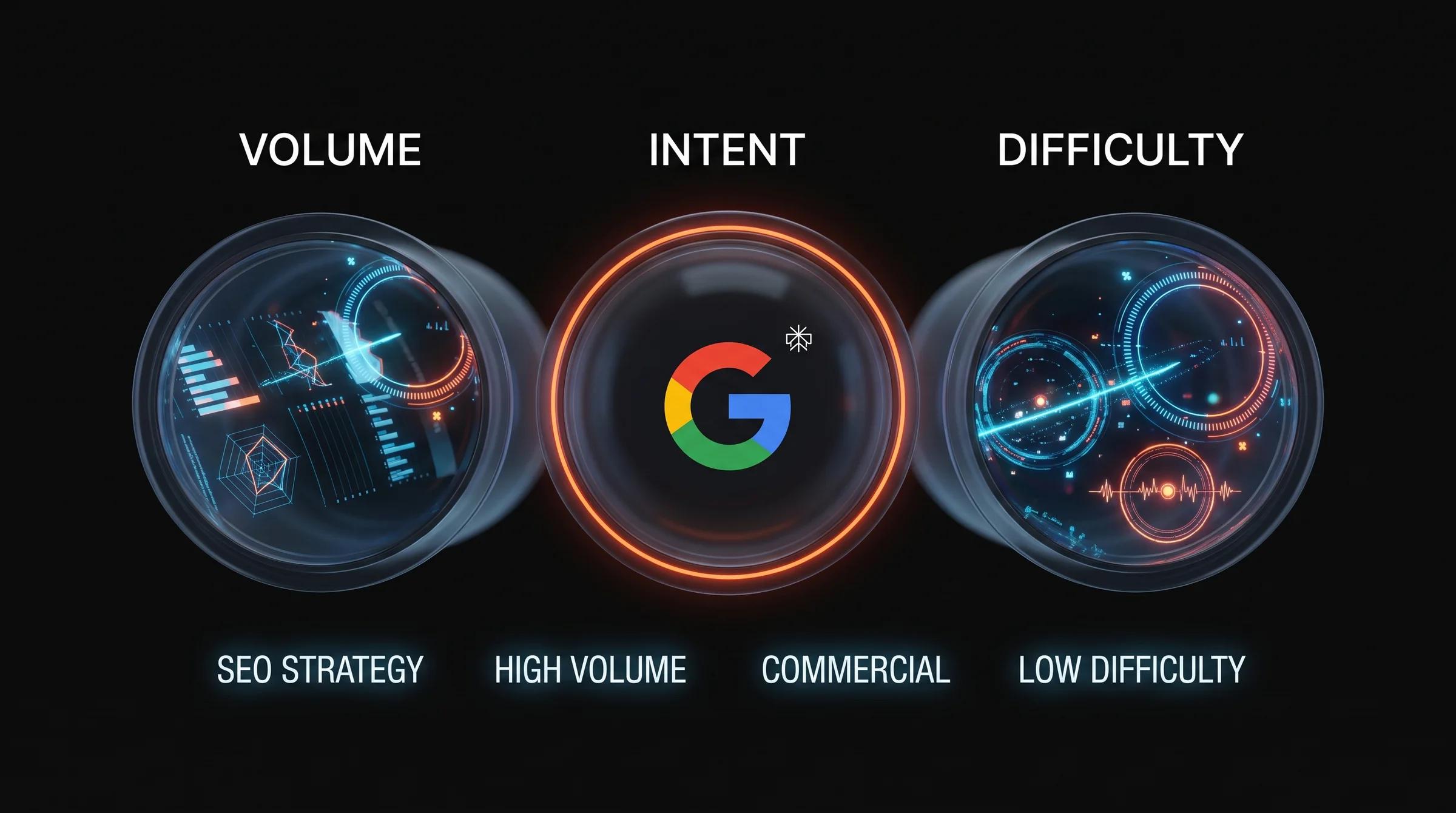
The Three-Lens Keyword Filter
A keyword that clears all three lenses belongs in your content calendar. A keyword that fails Lens 2 doesn’t belong on your list at any volume. And a keyword that fails Lens 3? You might rank for it and still earn nothing from it.
Lens 1: Traffic Potential - Not the Number on Your Screen
Traffic Potential is the realistic monthly traffic a keyword can deliver at your achievable rank position, accounting for actual click-through rates and AI Overview interception.
Here’s what matters: 94.74% of all keywords get 10 or fewer monthly searches. Over 70% of all search queries are long-tail. The head-term gold rush most marketers are mining represents a tiny, crowded sliver of actual search behavior.
The better play is keyword clusters. Twenty related terms averaging 300 searches each is a stronger opportunity than one 10,000-search keyword where you’ll realistically land on page two. The cluster earns topical depth. The home-run term earns frustration.
On keyword difficulty scores: treat them as a starting filter, not a verdict. A KD of 35 might look achievable until you open the actual SERP and see three government domains and two Wikipedia pages with 8,000 referring domains each. That score lied to you.
Two of the top five ranking pages having fewer than 30 referring domains each - that’s the real green light.
Quick check: Search your keyword in incognito mode. Count how many of the top 5 results are from sites in your authority range. A KD of 25 on a SERP full of Forbes, HubSpot, and G2 links is not a KD 25 opportunity for your site.
Lens 2: Revenue Signal - Where Intent Collides With Your Product
This is the lens most guides mention in a sentence and then ignore entirely.
Revenue Signal is the intersection of two things: what the searcher actually wants (their intent) and how directly your product solves that exact need. A keyword can be transactional and still have zero revenue signal for you if the searcher is trying to buy a competitor’s category.
Long-tail keywords score well on all three Revenue Signal questions. The specificity is the signal. When someone types “project management software for remote engineering teams under 20 people,” they’ve done the research. You just have to show up with the best answer.
Don’t overlook Jobs-to-Be-Done keywords because they look informational. “How to collect video testimonials from customers” seems like a how-to query - until you realize the searcher needs software to do it. If your tool solves that job, the revenue signal is strong regardless of the informational framing.
To score a keyword’s Revenue Signal quickly, answer three questions:
- Who’s searching? Is this person doing casual research, building a shortlist, or actively comparing to buy?
- Does solving their problem require what you specifically sell? Not your category. Your product.
- Are they aware they need a solution? The closer to that realization, the stronger the signal.
Lens 3: AI Visibility - The Filter That Rewrites Your Keyword Calendar
This is the filter that should be making content teams rethink everything.
Between June 2024 and February 2026, Seer Interactive tracked 2.43 billion organic impressions across 53 brands and 5.47 million queries. Their finding: organic CTR on AI Overview-present queries collapsed 61% (from 1.76% to 0.61%) by September 2025, then rebounded 85% to 2.4% by February 2026. The rebound matters. But so does the permanent gap: queries with AI Overviews now average 37% lower CTR than queries without them. That’s the new floor.
Meanwhile, AI Overviews appear on 48% of all Google queries as of March 2026 - up 58% from December 2025. Educational queries trigger AI Overviews on 83% of searches. B2B tech sits at 82%. Healthcare at 75%+. If your keyword list is heavy on informational topics in those verticals, you’re pouring content into a funnel with holes you can’t see.
But the part nobody talks about: websites cited inside AI Overviews earn 35% more organic clicks and 91% more paid clicks than non-cited pages on the same SERP. Being the cited source is now more valuable than ranking at position three.
So the question your keyword list must answer isn’t just “can I rank for this?” It’s: “if an AI Overview fires on this query, will my content be the one it cites - or will I rank and get zero clicks?”
A CXL study analyzing 100 Google AI Overview citations found that 55% of citations come from the first 30% of a page. Only 21% come from the bottom 40%. AI systems don’t read your entire article. They scan the top and extract the most direct answer they find.
Three keyword characteristics that correlate with getting cited:
- Question-format queries. “What is,” “How to,” and “Why does” queries trigger AI Overviews most frequently. If your keyword targets one of these, your content needs to answer it in the first 100-150 words - not after a three-paragraph narrative build-up.
- Topical cluster depth. Sites that consistently cover a subject from every angle earn AI citations at higher rates. AI engines pull from sources they recognize as authorities on a topic, not from sites with one great article and fifty unrelated pieces.
- Specificity and sourced facts. Vague overview content gets paraphrased. Specific, data-backed, entity-named content gets cited. A keyword that lets you write precise, well-sourced content beats a broader keyword that pushes you toward generic coverage every time.
The strategic takeaway: for every informational keyword you target, you need a plan for being the citation, not just the ranking. If the keyword triggers an AI Overview and your content isn’t structured to be cited, you’re building an asset that earns impressions and delivers nothing.
How to Score and Prioritize Your Keyword List
Start with the keywords your buyers actually type - not the ones your tool auto-suggests when you enter your product name. Ask your sales team what questions prospects repeat. Search your support tickets for recurring problems. Look at the exact language customers use before they understand they need you. That’s your real seed list.
Then run every candidate through this table:
| Keyword | Lens 1: Traffic Potential | Lens 2: Revenue Signal | Lens 3: AI Visibility Risk | Priority |
|---|---|---|---|---|
| “best accounting software” | High volume, very high competition | Commercial intent, broad audience fit | AI Overview likely, need topical cluster | Medium |
| “accounting software for freelancers” | Low-mid volume, low competition | Strong: specific buyer, direct fit | AI Overview possible, solid citation angle | High |
| “what is double-entry accounting” | Mid volume, low competition | Informational, minimal buying signal | High AI Overview risk, low click value | Low |
| “FreshBooks vs QuickBooks freelancers” | Low volume, very low competition | Extremely high: active comparison | AI Overview rare, strong click intent | High |
The highest-priority keywords aren’t the ones with the biggest numbers. They’re the ones closest to a buying decision and easiest to convert.
Here’s the four-step prioritization sequence:
- Pull 40-60 keyword candidates. No volume filter. Let everything in. Zero-volume queries you’ve heard from customers. Comparison terms for your top three competitors. Long-tail phrases from support tickets and sales call transcripts. All of it.
- Apply Lens 2 first. Cut any keyword where you can’t identify a clear buying trigger or a direct connection to your product. This step alone removes most of the junk from a typical keyword list.
- Apply Lens 1 to what survives. Open the actual SERP for each remaining keyword. Check referring domain counts on the top-ranking pages. Filter out anything where you’d be fighting sites with ten times your domain authority for a broad informational query with uncertain click-through.
- Tag Lens 3 risk. For any keyword where AI Overviews are likely to appear: flag the content brief to open with a direct answer, use clear H2/H3 structure, include named entities and original data points, and format FAQ sections as discrete answer units. That’s how you shift from “ranked but invisible” to “cited and clicked.”
One thing that gets treated as a publishing problem but is actually a selection problem: keyword cannibalization. Before any keyword makes your final list, search your own site for existing content targeting the same intent. Two pages competing for the same query dilute each other. Decide which page owns that keyword before you write, not after you publish.
Frequently Asked Questions About Choosing SEO Keywords
How many keywords should I target per page?
Target one primary keyword and two to four semantically related secondary keywords per page. The primary keyword anchors the topic - it goes in the H1, the opening paragraph, and the meta description. Secondary keywords surface naturally when you cover a topic comprehensively. One page trying to rank for twelve unrelated terms will rank strongly for none.
Is search volume still worth looking at?
Yes - as a tiebreaker, not a starting point. Search volume tells you about potential traffic reach. It says nothing about conversion likelihood or whether AI Overviews intercept those clicks. Evaluate Revenue Signal and ranking reality first. Use volume to decide between two equally strong options, not as your primary sort column.
What’s the difference between keyword difficulty and actual ranking difficulty?
Keyword difficulty is a tool-generated score based on the backlink profiles of pages currently on page one. Actual ranking difficulty depends on your site’s topical authority, how much better your content is than what’s currently ranking, the real composition of the SERP (a .gov page and a Wikipedia entry are fundamentally different obstacles than two thin blog posts), and whether AI Overviews have already reduced the click reward for ranking at all. Always check the SERP manually. KD is a filter, not a verdict.
Should I target keywords that show zero search volume in tools?
Sometimes, yes. Ahrefs, Semrush, and Google Keyword Planner all sample from limited data pools. Zero volume doesn’t mean zero searches. It often means the query isn’t in their dataset yet - common for specific product comparisons, emerging technology terms, and niche industry phrases. If a zero-volume keyword has strong Revenue Signal and directly mirrors questions your customers ask during the buying process, write for it. The traffic ceiling is low. The conversion rate can be exceptional because the audience is so specific.
How often should I revisit my keyword strategy?
Every six months at minimum for core topic clusters, and immediately after any major Google core update or product change. AI Overviews grew from 6.49% of queries in January 2025 to 48% by March 2026, and commercial and navigational queries now trigger them at dramatically higher rates. A keyword strategy built in early 2025 may already be sending you toward queries where AI Overviews swallow most clicks [1]. Sixty percent of Google searches now end without a click, according to SparkToro data. Static keyword lists have never had a shorter shelf life.
How do I pick keywords that work for AI search engines like ChatGPT?
Optimize for traditional search first - 92.36% of AI Overview citations come from domains already ranking in the top 10. But add a layer: target question-format keywords, structure answers in the first 150 words, build topical clusters instead of isolated articles, and include original data points AI can cite. The same content that ranks well typically gets cited by AI systems. Google’s Danny Sullivan confirmed this directly: “Good SEO is good GEO” [2].
Conclusion
The old keyword selection model - sort by volume, filter by difficulty, check intent - was built for a search environment that no longer exists. AI Overviews now appear on nearly half of all queries and climbing. Conversion data has been proving for years that broad informational traffic doesn’t convert. The gap between “we rank for it” and “it grows our business” is wider than ever.
The Three-Lens Filter doesn’t need new tools. It needs a different sequence: Revenue Signal first, Traffic Potential second, AI Visibility as the final check. Start there. You’ll build a keyword list that earns revenue, not just rankings.
If you’d rather have a team apply this framework against your site and competitors, LoudScale builds keyword strategies grounded in exactly this methodology for growing B2B and e-commerce brands. Learn about our [SEO keyword research services] or read our [complete guide to AI search optimization].
Sources
- QuickSEO, “Google AI Overviews Statistics 2026: 60+ Data Points Every SEO Should Know” (May 2026): https://quickseo.ai/blog/google-ai-overviews-statistics-2026-60-data-points-every-seo-should-know
- Whitehat SEO, “Keyword Research in 2026: The Complete B2B Guide” (April 2026): https://whitehat-seo.co.uk/blog/secrets-of-keyword-research
- Grow and Convert, “What’s the Average Conversion Rate of Different SEO Keywords?” (January 2026): https://www.growandconvert.com/conversion-rate-optimization/average-seo-conversion-rate/
- CXL, “Where Google AI Overviews Cite From: A 100-Page Study” (March 2026): https://cxl.com/blog/google-ai-overview-citation-sources/
- Digital Applied, “Google AI Overviews Surge 58%: SEO Impact Analysis” (March 2026): https://www.digitalapplied.com/blog/google-ai-overviews-surge-58-percent-queries-seo-impact
- Slug GeneratorTurn chosen keywords into URL-safe slugs.
- AI Visibility ReadinessScore AI Visibility Readiness (not live mentions) free.
- SEO CheckerLive on-page extractability, schema, and trust checks.
Diagnostics show a useful score before email. Explore LoudScale services when you want a full plan and implementation.

LoudScale Team
Growth Marketing Specialists
The LoudScale team shares practical strategies and experiments across search and AI visibility, content authority, B2B lead generation, lifecycle systems, analytics, and responsible AI.