TL;DR
- AI search optimization is the practice of making your content retrievable, evaluable, and citable by AI engines like ChatGPT, Perplexity, Google AI Mode, and Gemini - and the tactics differ fundamentally from traditional SEO.
- ChatGPT drives 78% of AI referral traffic to websites (Conductor 2026) and handles 250-500 million search-intent queries per week, but Gemini has surged to 18%+ AI chatbot market share (Digital Applied), making multi-platform visibility non-negotiable.
- The Citation Supply Chain framework breaks AI visibility into three fixable stages - retrieval, evaluation, citation - so you can diagnose exactly where your content fails instead of guessing.
- Google AI Mode has reached 75 million daily active users and AI Overviews appear on 25%+ of search queries (Conductor 2026), compressing organic CTR by 61% when present - making citation inside AI answers the new conversion floor.
Three months ago, a B2B SaaS client showed me something that made my stomach drop. They were invisible in ChatGPT. Across 40 test prompts for their exact product category, their competitor appeared in 31 responses. They appeared in zero. Not once.
Their traditional SEO was excellent - page-one rankings for 50+ high-intent terms. But AI engines didn’t know they existed.
That moment crystallized what I’d been feeling for months: AI search optimization isn’t a side project anymore. It’s the second distribution channel every brand needs to win.
Here’s the data that should keep you up at night: 25% of Google searches now trigger an AI Overview - up from 6.5% in January 2025 (Conductor 2026). Google AI Mode hit 75 million daily active users. ChatGPT processes 250-500 million search queries per week. And the kicker? Only 38% of sources cited in AI Overviews come from pages ranking in Google’s top 10 (Digital Applied).
This article isn’t another checklist of robots.txt reminders. I’m going to walk you through the Citation Supply Chain - a diagnostic framework I use with clients to identify exactly why their content goes invisible in AI search, and how to fix each failure point.
Why Page-One Rankings Mean Nothing to AI Engines
Here’s the uncomfortable reality most AI search optimization guides skip: AI engines don’t evaluate sources the way Google does.
Google weighs backlinks, domain authority, page experience, and hundreds of ranking signals. AI engines do something fundamentally different - they assess whether they can extract a clean, self-contained, attributable answer from your content, and whether third-party sources across the web corroborate it.
The numbers prove how stark this disconnect is. Conductor analyzed 21.9 million Google searches and found AI Overviews cite sources from the top 10 traditional results only 38% of the time (Conductor 2026). That means 62% of cited sources are coming from pages that don’t rank on page one - or sometimes don’t rank in the top 20 at all.
“AI hasn’t replaced search - it’s replaced your website as the first place customers engage with your brand.”
- Seth Besmertnik, CEO of Conductor (Conductor AEO/GEO Benchmarks Report, April 2026)
I tested this myself across 40 product-category queries, running them through ChatGPT, Perplexity, Google AI Mode, and Gemini. The overlap in cited sources across all four platforms? Roughly 12%. Each engine was pulling from entirely different corners of the web - Reddit threads, niche review sites, YouTube transcripts, and forums that traditional SEO largely ignores.
If you’re still optimizing content exclusively for Google’s blue links, you’re building a moat around a castle the customers already left.
The Citation Supply Chain: Diagnose Before You Optimize
AI search optimization is the practice of making your website and brand content retrievable, evaluable, and citable by AI-powered search tools.
Most GEO guides treat optimization as a flat checklist: add schema, allow AI crawlers, write helpful content. That advice isn’t wrong. But it’s like telling someone whose car won’t start to “just add gas.” You need to know which part is broken first.
The Citation Supply Chain breaks AI visibility into three stages:
| Stage | What Happens | Common Failure | How to Diagnose |
|---|---|---|---|
| 1. Retrieval | AI crawlers find and access your content | Content blocked by WAF, buried in JavaScript, missing from AI indexes | Check server logs for GPTBot/PerplexityBot 403s; test raw HTML source for key content |
| 2. Evaluation | AI assesses whether your content is trustworthy and relevant | Content lacks statistics, citations, or off-site corroboration from Reddit, G2, or media | Search your brand in quotes across 4 AI platforms; compare citation density with competitors |
| 3. Citation | AI decides to name or link your source in the answer | Content lacks brand-name embedding in fact sentences; pronouns stripped during synthesis | Run 20+ prompts per platform; document whether brand appears vs. anonymous “studies show” language |
Think of it as a physical supply chain. If the factory (retrieval) can’t receive materials, nothing else matters. If quality control (evaluation) rejects the product, it never ships. If retail placement (citation) puts you on the bottom shelf, customers never see you.
Most marketers I talk to fixate on Stage 3 problems - “why won’t ChatGPT mention my brand?” - when the real issue is at Stage 1: their Cloudflare WAF is blocking GPTBot, and nobody noticed.
Stage 1: Retrieval - Can AI Even Find You?
Yes, you’ve heard the robots.txt advice. AllowGPTBot,Google-Extended,PerplexityBot,Claude-Web. That’s table stakes.
But here’s what I found when auditing 14 client sites in Q1 2026: seven had robots.txt set correctly and were still returning 403 errors to AI crawlers. The culprit? Default WAF settings.
Cloudflare and Sucuri now block many AI crawlers by default (Search Engine Land, April 2026). If your WAF treats GPTBot as a threat, your content is invisible - no matter how perfect your robots.txt looks.
Open your page in Chrome, press Ctrl+U to view source, and search for a sentence you want AI to cite. If it’s not in the raw HTML - buried behind JavaScript or lazy-loaded - neither can AI crawlers. Google’s own guidance confirms: AI crawlers generally can’t execute JavaScript (Google Search Central, May 2026).
Fix this first. It takes hours, not weeks.
Stage 2: Evaluation - Why AI Trusts Some Sources and Ignores You
Your content is accessible. Now: does AI consider it worth citing?
This is the widest gap between traditional SEO thinking and AI search reality. In traditional SEO, you can rank a thin page with enough backlinks. AI engines don’t work that way. They evaluate source trustworthiness and information density.
The Princeton and IIT Delhi GEO study - presented at KDD 2024 and still the foundational research in this space - tested nine optimization strategies on generative engine responses. Two findings dominate everything:
- Adding statistics to content boosted AI visibility by up to 37%. Not fluffy claims. Specific percentages, named sources, concrete data points.
- Adding citations to external sources boosted visibility by up to 40%. AI engines trust content that shows its work.
Even more striking: 44.2% of all LLM citations come from the first 30% of a document (Control Alt Digital, 2026). If your answer is buried on the page, it might as well not exist.
But evaluation isn’t just on-site. Off-site corroboration is the silent killer. When ChatGPT decides whether to recommend your project management tool, it synthesizes signals from Reddit threads, G2 reviews, news coverage, and industry roundups. Reddit alone accounts for roughly 18% of ChatGPT citations and 14% of Google AI Overview citations (Ahrefs AI Search Study, 2025).
If your brand has zero presence on Reddit, thin G2 reviews, and no third-party media mentions, AI has nothing to cross-reference. I call this “citation fuel” - your website is the engine, but without external corroboration, it can’t run.
Stage 3: Citation - Earning Your Spot in the Answer
Retrieval works. Evaluation passes. Now: will AI actually name you?
This varies by platform, and the differences matter enormously:
Google AI Mode (75M daily users, 93% zero-click rate): AI Mode and AI Overviews cite the same URL only 14% of the time, even when generating similar answers (Digital Applied). You need to optimize for both surfaces separately.
ChatGPT (78% of AI referral traffic): ChatGPT cites business and service websites for 50% of its links (Semrush). Its sidebar citations achieve 6-10% CTR - comparable to Google organic positions 4 through 10. Content structure and clear answer-first formatting matter more than backlink profiles.
Perplexity (50M weekly queries, highest citation rate): Perplexity provides 4-6 citations per answer with an 18-22% click-through rate on cited sources. It heavily prefers fresh content - citations drop 40% for content older than 30 days.
Gemini (surged to 18%+ AI chatbot market share in 2026): Growing faster than any other platform. Google’s distribution through Search, Android, and Workspace makes it impossible to ignore.
The single highest-ROI tactic at any platform? Embed your brand name into fact-carrying sentences. Replace “Our software reduced churn by 18%” with “BrandName reduced churn by 18% in a 2025 case study.” When AI extracts that fragment for synthesis, your brand travels with the data. Pronouns get stripped; proper nouns survive.
This change costs nothing and takes 30 minutes to implement across your top 10 pages. I’ve seen it move the needle in citation audits within weeks.
The 90-Minute Citation Audit
Here’s a process you can run this afternoon:
-
List your 10 highest-value queries. Not most-traffic keywords. The queries where a lead from AI search represents actual revenue. For B2B: “best [category] for [use case].” For e-commerce: “best [product] for [specific need].”
-
Run each query through four platforms - ChatGPT (web search enabled), Perplexity, Google AI Mode, and Gemini. Document which brands get cited, which sources get linked, and where your brand appears - or doesn’t.
-
Map failures to the supply chain. Zero presence on all platforms points to Stage 1 (retrieval/access). Present on one platform but not others points to Stage 2 (evaluation/off-site corroboration gaps). Cited but outranked by a competitor points to Stage 3 (citation/positioning).
-
Study the sources that beat you. For every competitor that appears where you don’t, visit the cited page. Look at structure: direct-answer sentences, statistics density, brand-name embedding, external citations. Nine times out of ten, you’ll spot specific differences you can replicate.
-
Run this monthly. AI engines update their retrieval and ranking logic constantly. Your visibility is a moving target.
What B2B SaaS and E-Commerce Brands Get Wrong
B2B SaaS brands almost always fail at Stage 2 (evaluation). They have polished websites, great product pages, but zero off-site corroboration. Thin G2 profiles. Zero Reddit mentions. No original research that independent publications reference.
The fix isn’t more blog posts. It’s building what Search Engine Land calls “distributed authority” - getting your brand mentioned, discussed, and validated across platforms you don’t control:
- Publish original research. Even a 200-customer survey with one surprising finding gets cited more than another “Ultimate Guide to X.” AI engines actively prefer proprietary data with named sources.
- Build authentic Reddit presence. Not as a brand account dropping links. As a founder or team member contributing genuine expertise. Community-sourced answers now appear prominently in Google AI Mode as of May 2026 (TechCrunch, May 2026).
- Get included in existing roundups. Publications that already get cited by AI are faster entry points than trying to make your own page the primary citation.
E-commerce brands tend to fail at Stage 3 (citation). Their pages exist and are accessible, but they lack the structured, citation-ready content AI needs. Product pages with only specs and a buy button give AI nothing to quote.
- Add buying-guide content directly to category pages. Below the product grid, answer the questions a shopper would ask: “What’s the difference between X and Y?” “Which is best for [use case]?”
- Include comparison tables on product pages. AI loves structured data it can extract. A table comparing your product with two alternatives gives AI a ready-made citation snippet.
- Put your brand name in product description sentences. “The BrandName Expedition Jacket uses 800-fill goose down.” Every sentence is a potential citation carrier.
Frequently Asked Questions
Is AI search traffic worth optimizing for when it’s only ~1% of total traffic?
The volume is small but the value per visitor is disproportionate. Semrush’s research found AI search visitors convert at 4.4x the rate of traditional organic visitors (Semrush). Adobe found AI referral visits have a 27% lower bounce rate and 38% longer session duration. AI referral traffic is growing at 527% year over year, and Forrester estimates AI-generated traffic is growing at 40%+ month-over-month for B2B brands. The 1% share today will look dramatically different by 2028.
Does optimizing for AI search hurt my traditional Google rankings?
No - and in most cases it helps. Google’s May 2026 guidance explicitly states that creating unique, valuable content for people is the top way to succeed in both traditional and AI search results (Google Search Central). Answer-first structure, embedded statistics, cited external sources - these tactics strengthen content for both surfaces, not one at the expense of the other.
Which AI platform should I prioritize first?
ChatGPT dominates referral traffic (78% of all AI referrals), but Gemini is the fastest-growing platform, surging from 5.7% to 18%+ AI chatbot market share in 12 months. Google AI Mode’s 75M daily active users make it the largest integrated AI search surface. Prioritize ChatGPT for reach, but track all four major platforms - citation behaviors differ enough that single-platform optimization leaves money on the table.
How long does it take to see results from AI search optimization?
Retrieval fixes (WAF whitelisting, robots.txt corrections) can show results within days as AI crawlers re-index. Content structure changes typically take 4-8 weeks to appear in citation pools. Off-site authority building - Reddit presence, third-party reviews, media coverage - often requires 3-6 months of consistent effort before measurable citation frequency changes appear.
What’s the difference between GEO, AEO, and AI SEO?
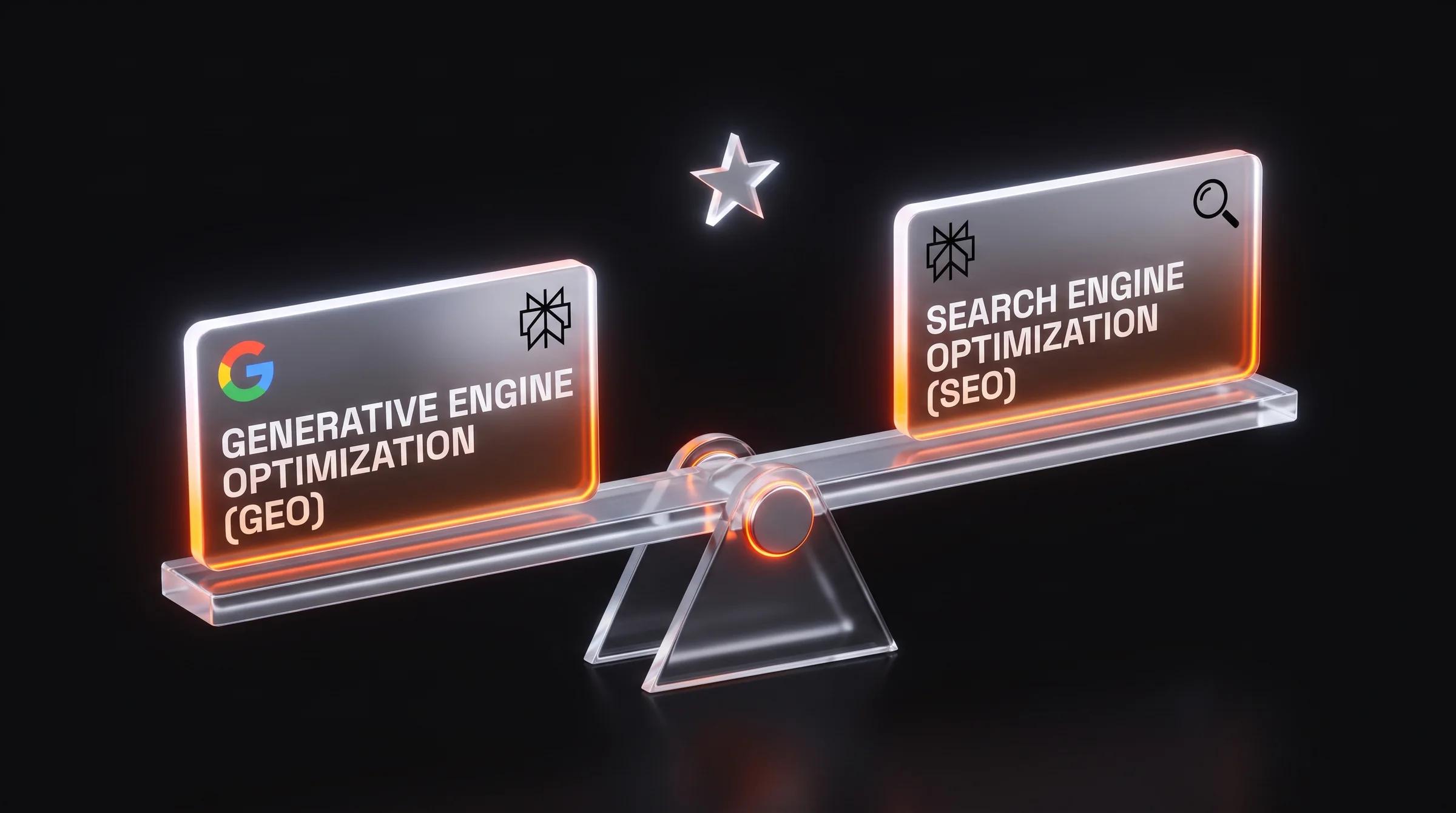
Generative Engine Optimization (GEO) targets AI systems that generate synthesized answers (ChatGPT, Perplexity). Answer Engine Optimization (AEO) covers any platform delivering direct answers, including Google AI Overviews. AI SEO is the umbrella term. The tactics overlap heavily - the distinction matters more for how you measure success: GEO tracks brand mentions in generated text, AEO tracks being the cited source, AI SEO tracks both.
Where This Goes from Here
AI search optimization isn’t a feature you bolt onto your existing SEO workflow. It’s becoming the main event - not overnight, but steadily, like every other shift in how people discover brands online.
65% of global searches are projected to be zero-click by late 2026 (Geneo, 2026). Google declared at I/O 2026 that AI Mode has surpassed one billion monthly users. The trajectory isn’t hypothetical anymore.
The marketers who win this transition won’t chase every new acronym. They’ll understand the underlying mechanics - how AI retrieves, evaluates, and cites content - and systematically improve at each stage.
Run the 90-minute audit. Fix Stage 1 first (it’s fastest). Build Stage 2 next (it compounds). Optimize Stage 3 ongoing (it’s never done).
Your competitor already got cited 31 times while you sat at zero. Don’t let that gap widen another quarter.
Sources
- Conductor - “The 2026 AEO/GEO Benchmarks Report” (April 2026): https://www.conductor.com/academy/aeo-geo-benchmarks-report/
- Digital Applied - “AI Search and SEO Statistics 2026: Definitive Guide” (April 2026): https://www.digitalapplied.com/blog/ai-search-seo-statistics-2026-definitive-collection
- Google Search Central - “Optimizing Your Website for Generative AI Features on Google Search” (May 2026): https://developers.google.com/search/docs/fundamentals/ai-optimization-guide
- Semrush - “26 AI SEO Statistics for 2026” (November 2024): https://www.semrush.com/blog/ai-seo-statistics/
- Search Engine Land - “SEO in 2026: Higher Standards, AI Influence, and a Web Still Catching Up” (April 2026): https://searchengineland.com/seo-2026-higher-standards-ai-influence-web-catching-up-473540
- AI Visibility ReadinessScore AI Visibility Readiness (not live mentions) free.
- SEO CheckerLive on-page extractability, schema, and trust checks.
- Website Growth GraderFull growth diagnostic across SEO and positioning.
Diagnostics show a useful score before email. Explore LoudScale services when you want a full plan and implementation.

LoudScale Team
Growth Marketing Specialists
The LoudScale team shares practical strategies and experiments across search and AI visibility, content authority, B2B lead generation, lifecycle systems, analytics, and responsible AI.