TL;DR
- 64.82% of Google searches now end without a click, and the March 2026 core update shifted 79.5% of top-3 rankings - which means the four SEO pillars aren’t just nice-to-have concepts anymore. They’re your lifeline.
- Use the Pillar Priority Matrix to find your bottleneck: crawl issues → fix technical SEO; pages indexed but not ranking → fix content; stuck at positions 8–15 → fix off-page authority.
- Google’s own Danny Sullivan said it plain: “Good SEO is good GEO.” But the nuance nobody tells you? Which pillar you fix first changes everything.
I watched a site lose 43% of its organic traffic in March 2026. Not a slow decline. Not a seasonal dip. The core update landed and their rankings imploded within four days. The site loaded fast. The content read well. The backlinks looked fine at a glance. What failed? They’d published 300 blog posts across 40 unrelated topics with zero original data, no named authors, and template-style headings. Thin content dragged down every other pillar like a lead weight.
That’s the thing about SEO pillars. Most articles describe them like a checklist. Do this, then that, then the other thing. But the four pillars of SEO don’t work in sequence. They work like load-bearing walls. One collapses, and the rest can’t hold anything up.
Here’s what you won’t find in a dozen other “pillars of SEO” articles on page one: a way to diagnose which pillar is your actual bottleneck, real 2026 data on how each pillar connects to AI search visibility, and a framework you can test on Monday morning.
What are SEO pillars, and why do they still matter in 2026?
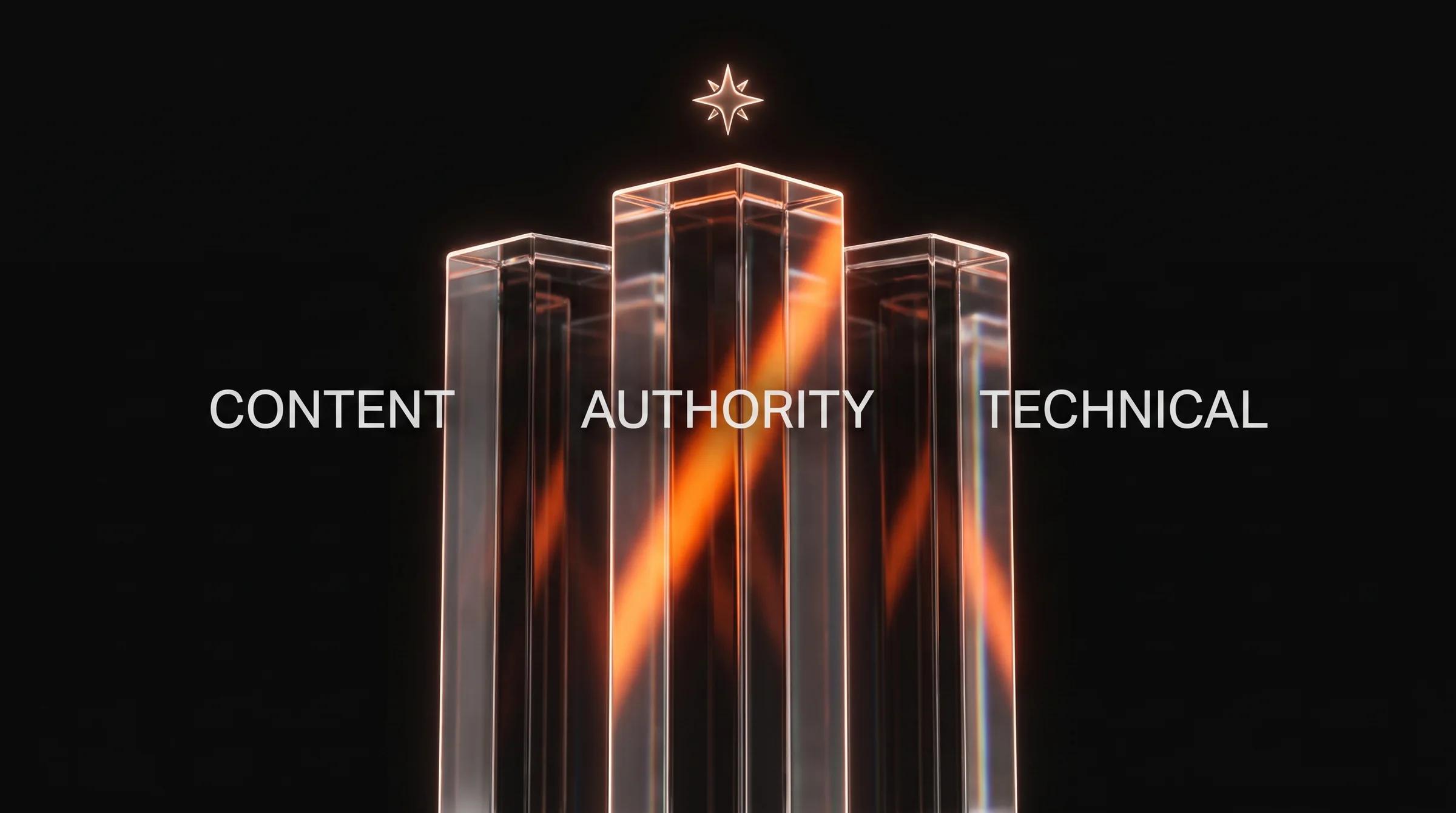
SEO pillars are the four foundational categories - technical, on-page, content, and off-page - that determine whether search engines (and now AI platforms) can find, understand, trust, and cite your pages. Think of them as the four legs of a table. The tablecloth changes with the season, but the legs are structural.
The stakes have shifted dramatically. Google’s March 2026 core update caused 79.5% of top-3 URLs to change positions and pushed nearly one in four top-10 pages out of the top 100 entirely, according to SE Ranking data shared with Search Engine Land [[1]]. The update rewarded expert-authored research and branded, data-rich sources while hitting aggregators, directories, and template-driven content hard.
Meanwhile, zero-click searches are at 64.82% [[2]], and AI search traffic grew 527% year-over-year [[3]]. The clicks that survive are worth more - Semrush found AI-referred visitors convert 4.4x higher than traditional organic visitors [[3]] - but they go to sites with all four pillars working together.
What surprised me: AI platforms don’t bypass these pillars. They lean on them harder. Semrush analyzed 5 million cited URLs in January 2026 and found pages cited by Google AI Mode had Organization schema at a 34% implementation rate, Article schema at 26%, and BreadcrumbList at 20% [[4]]. That’s not a coincidence. Structure matters to large language models, even if - as Ahrefs found more recently - adding schema alone to already-cited pages doesn’t budge citation volume [[5]]. The foundation matters. The checklist alone doesn’t.
The Pillar Priority Matrix: which pillar should you fix first?
I’ve audited a lot of sites, and I’ve noticed a pattern. Every underperforming site has a primary bottleneck. Fix that one bottleneck for 30 days, and the other three pillars start producing results almost immediately. Keep ignoring it, and every hour you spend elsewhere is wasted effort.
Here’s the diagnostic framework I use:
| Symptom You’re Seeing | Likely Broken Pillar | First Move |
|---|---|---|
| Pages not getting indexed despite being published for weeks | Technical (crawlability or rendering) | Run a Screaming Frog crawl, fix orphan pages, verify robots.txt isn’t blocking |
| Pages indexed but ranking nowhere near page 1 for target keywords | Content (thin, missing search intent, no Information Gain) | Rewrite top 10 pages for intent match and add one original data point per page |
| Rankings trapped at positions 8–15, can’t break top 5 | Off-page (low domain authority, few referring domains from relevant sites) | Build 5–10 links from topically relevant domains to the stuck pages |
| High impressions but terrible click-through rate | On-page (weak titles, nondescript meta descriptions) | A/B test new title tags on your top 20 impression pages for 2 weeks |
| Traffic drops after every Google core update | Content + Technical (quality signals failing simultaneously) | Audit E-E-A-T signals and Core Web Vitals in the same sprint |
| Competitors outrank you with objectively weaker content | Off-page (they have higher domain authority in your niche) | Analyze competitor backlink profiles, identify the domains linking to them but not you |
Stop fixing everything at once. Find your bottleneck. Fix it. Measure for 30 days. Then rotate.
Pro tip: Run this diagnostic quarterly. Your bottleneck shifts. A site that fixed its technical foundation six months ago might now be held back by weak content or thin backlinks. The weakest pillar rotates.
Pillar 1: Technical SEO (the foundation nobody sees)
I once had a client tell me their content was “objectively better than anyone’s in their space.” I ran a crawl. Their site had 12,000 pages. Googlebot could reach about 3,200 of them. The rest were trapped behind JavaScript rendering failures, redirect chains, and a robots.txt block they’d forgotten about. Their amazing content was invisible. It didn’t matter how good it was.
Technical SEO is the infrastructure layer: site speed, Core Web Vitals, crawl architecture, HTTPS, structured data, mobile responsiveness, and clean URLs. It’s the plumbing. Nobody notices good plumbing. Everyone notices when it breaks.
Three things changed in the technical pillar in 2026 worth knowing about. First, the March 2026 core update made Information Gain a dominant ranking signal [[6]]. Google now explicitly evaluates whether your content adds something new compared to pages that already rank. That’s not technical per se, but it means your crawl budget matters more than ever - if Google can’t reach your best pages, it can’t evaluate your Information Gain.
Second, Semrush’s January 2026 study of 5 million AI-cited URLs found that URL slugs between 17 and 40 characters received the most citations across AI platforms [[4]]. Concise but descriptive. Not keyword-stuffed, not cryptically short.
Third, Ahrefs dropped a bomb in May 2026. They tracked 1,885 pages that added JSON-LD schema markup and found no meaningful citation uplift on Google AI Mode or ChatGPT [[5]]. For pages already getting cited, schema alone didn’t move the needle. But that doesn’t make schema worthless - for pages not yet in the AI consideration set, structured data may help crawlers discover and parse content in the first place. The study found 53% of AI-cited pages already have schema. Correlation, not causation, but the better-maintained sites that do technical SEO well also do everything else well.
What to prioritize right now
- Fix crawlability. Run a Screaming Frog or Sitebulb audit monthly. Find orphan pages, redirect chains, blocked resources. If crawlers can’t reach it, nothing else matters.
- Hit Core Web Vitals thresholds. LCP under 2.5 seconds, INP under 200ms, CLS under 0.1. The March 2026 update confirmed Core Web Vitals still function as a tiebreaker and quality proxy [[6]].
- Test schema where it makes sense. Organization, Article, BreadcrumbList, and FAQ types consistently correlate with AI citations whether or not they cause them. Implement what fits your content. Don’t expect miracles.
Pillar 2: On-page SEO (where intent meets execution)
I watched a SaaS company hold position 2 for a competitive keyword with mediocre domain authority. Their secret wasn’t backlinks. It was obsessive on-page optimization. Every heading mapped to a user’s unspoken question. Every meta description read like a targeted pitch. Their internal linking connected related pages in a tight, logical cluster. On-page SEO punches above its weight class.
On-page SEO covers everything on a specific page you control directly: title tags, meta descriptions, heading hierarchy, keyword placement, internal linking with descriptive anchor text, image optimization, and URL structure. It’s how you tell Google - and increasingly, AI systems - what your page is about.
But “on-page” in 2026 means something broader. AI search engines pull standalone sentences from your content to answer user queries. Only 8% of users click a traditional link when an AI summary appears [[3]], according to Pew Research. The sentence that gets cited is your organic result now. Every important statement on your page needs to work in isolation. “It increased by 30%” is useless as a citation. “Organic CTR for position-one results dropped 58% when AI Overviews were present, according to Ahrefs’ December 2025 analysis” is citable.
On-page elements that matter most for dual visibility
- Title tags that match intent word-for-word. If someone searches “fix crawl errors,” your title should use “fix crawl errors.” Not a synonym. Not a creative rewrite. Front-load the exact query language.
- Heading hierarchy that follows the reader’s thought process. H2s for major questions, H3s for sub-questions. AI systems parse heading structure to assess topic coverage.
- Self-contained answer sentences within the first 100 words of each section. Lead with a direct answer, then expand. That’s the inverted pyramid format that AI Overviews pull from.
- Internal links with descriptive, varied anchor text. “Click here” is dead. “Learn more about [our technical SEO approach]” gives crawlers a topic signal. Vary anchor phrasing across pages - using the same anchor text on every post raises templating flags.
Pillar 3: Content (the one everyone thinks they’re doing well)
I need to be straight about this: most companies I’ve audited believe their content is better than it is. They’ve published 200 posts, covered every keyword, and wonder why traffic stays flat. Then I open the content and find 200 versions of the same article ten other sites already wrote. No original data. No first-hand experience. No perspective that challenges the consensus.
The March 2026 core update weaponized Information Gain as a ranking signal. Digital Applied’s analysis found thin content dropped 30–50%, 71% of affiliate sites saw negative impact, and AI content farms without editorial review lost an average of 45% [[6]]. Sites publishing original research and E-E-A-T-rich content gained 15–25%.
Google has a patent on Information Gain scoring - a metric that measures how much genuinely new knowledge your content adds compared to existing top-ranking pages [[6]]. Content that rehashes what ten other articles cover doesn’t just fail to stand out. It actively gets demoted. The May 2026 core update, which started rolling out May 21, signals Google isn’t backing off this direction.
“If your blog exists solely to rank, it’s living on borrowed time.”
- John Mueller, Google Search Advocate, quoting an article on Bluesky (December 2025) [[7]]
What makes content work in 2026
Forget word count. Forget publishing frequency. Here’s what separates content that performs from content collecting dust at position 53.
E-E-A-T is no longer theoretical. Experience, Expertise, Authoritativeness, and Trustworthiness aren’t direct ranking factors - Google’s own documentation says as much. But Google uses a mix of signals that identify content with good E-E-A-T [[8]], and every 2025–2026 core update has amplified those signals. Affiliate sites without hands-on product testing data cratered in March 2026.
Original data travels further. I’ve seen a 700-word post with original survey data outrank a 4,000-word guide with zero original insights. AI systems love citing specific numbers, named studies, and unique findings. If you can generate your own data - run a survey, share internal benchmarks, analyze your customer base - you’re producing content both Google and AI engines want to surface.
Topical depth beats topical breadth. Publishing 40 thin articles on 40 different keywords loses to publishing 12 deep articles that cover a topic cluster exhaustively. Topical authority has become more measurable and more impactful after every 2025–2026 core update.
Pillar 4: Off-page SEO (the reputation layer)
Here’s the question that trips people up: if your content is great and your site is technically flawless, why would you still need backlinks?
Because Google doesn’t evaluate your content in a vacuum. It evaluates what the rest of the internet thinks about your content. Off-page SEO is the trust layer. It’s the difference between a stranger saying they’re an expert and a room full of respected peers nodding along.
Off-page SEO covers signals from outside your site: backlinks, brand mentions, social validation, and citations across the web. Backlinks remain the strongest of these signals. A Backlinko study cited by Search Engine Land found that domain-level link authority - measured by Ahrefs Domain Rating - still strongly correlates with higher rankings [[9]].
But off-page SEO is shifting in a way that changes your calculus. Backlinks don’t just help you rank on Google. They help you get cited by AI. Semrush’s October 2025 study of 1,000 domains found that Authority Score - driven heavily by backlink quality and referring domain diversity - correlates strongly with AI mention frequency (Pearson: 0.65) [[10]]. That’s not small. AI models are trained on web data. Sites that other credible sites link to are, by definition, more prominent in training data and retrieval-augmented generation (RAG) pipelines.
And here’s the stat that flips the ROI math: AI search visitors are worth 4.4x more than traditional organic visitors from a conversion perspective [[3]]. Fewer clicks, but each one is more qualified. Off-page authority helps you capture those high-value visits.
What actually builds off-page authority in 2026
- Original research that earns links naturally. Publish data, studies, or frameworks other sites want to reference. This article’s Pillar Priority Matrix is built for that - useful, not a link-swap request.
- Digital PR with topical relevance. One link from a relevant, authoritative domain beats fifty links from sites unrelated to your niche. Get mentioned in industry publications that cover your space.
- Brand mentions without links still count. Google’s algorithms evaluate unlinked brand mentions as authority signals. People talking about your brand on Reddit, in podcasts, or in industry forums contributes to your footprint even without a hyperlink.
How the four SEO pillars connect to AI search visibility
Most pillar articles stop at describing the four categories. But the question worth answering: how do these pillars specifically influence whether you show up in AI-generated answers?
| SEO Pillar | Traditional Google Signal | AI Visibility Connection | Key Data Point |
|---|---|---|---|
| Technical | Crawlability, speed, schema | AI crawlers need parseable HTML; well-structured URLs perform better | URL slugs 17–40 chars receive most AI citations [[4]] |
| On-page | Title tags, headings, keyword placement | AI extracts self-contained sentences for direct citation | Only 8% of users click links when AI summaries appear [[3]] |
| Content | Quality, depth, E-E-A-T, Information Gain | Original data and unique insights get cited; rehashed content doesn’t | 50% of ChatGPT citations go to business/service sites [[3]] |
| Off-page | Backlinks, domain authority | High-authority domains appear more in AI training data and RAG retrieval | AI visitors convert 4.4x higher than traditional organic [[3]] |
Danny Sullivan said it at WordCamp US in August 2025: “Good SEO is good GEO.” [[11]] He’s right - the four pillars aren’t separate from AI optimization. They are AI optimization. But the prioritization matters. Fix the wrong pillar first and you’re polishing brass on a ship that’s taking on water.
Frequently Asked Questions About SEO Pillars
What are the 4 pillars of SEO?
The four pillars of SEO are technical SEO, on-page SEO, content, and off-page SEO. Technical SEO covers crawlability, site speed, and structured data. On-page SEO includes title tags, headings, and internal linking. Content refers to quality, depth, originality, and Information Gain - what unique value your pages offer. Off-page SEO is everything outside your site, primarily backlinks and brand mentions, that signals trust to search engines.
Which SEO pillar is the most important?
No pillar is universally most important. A site with great content but broken crawlability needs technical work first. A technically sound site with thin content needs content investment. Use the Pillar Priority Matrix in this article to diagnose your specific bottleneck based on observable symptoms.
Do SEO pillars still matter with AI search and AI Overviews?
The four SEO pillars matter more, not less. Semrush found that pages cited by ChatGPT and Google AI Mode had stronger technical foundations and more structured data than uncited pages [[4]]. Google’s Danny Sullivan has stated that “good SEO is good GEO” [[11]]. The same fundamentals that drive traditional rankings also drive AI visibility.
How often should you audit your SEO pillars?
Quarterly. Run a technical crawl, review on-page optimization for top-performing pages, assess content freshness and E-E-A-T signals, and check your backlink profile. Your weakest pillar rotates over time, so regular reassessment prevents you from over-investing in a pillar that’s already strong.
Is off-page SEO still about backlinks?
Backlinks remain the strongest off-page signal, but off-page SEO now includes unlinked brand mentions, AI citations, and social signals. Semrush’s October 2025 study found that domains with higher authority and more quality backlinks appeared more frequently in AI-generated answers [[10]], meaning link building now serves both traditional and AI search visibility.
Your four pillars, one priority
I’ve read a lot of SEO pillar articles. They describe the same categories with the same advice. They’re not wrong. But knowing the four pillars exist was never the hard part. Knowing which one to fix right now, on your site, with your budget and timeline - that’s the skill.
Use the Pillar Priority Matrix. Find your bottleneck. Fix it for 30 days. Measure. Then rotate. That’s the system that works in practice.
And if you’d rather have a team handle the diagnosis and execution, LoudScale builds SEO strategies that account for both traditional rankings and AI search visibility.
If you want to go deeper: read our SEO strategy framework for a complete execution plan, or our technical SEO audit guide to fix crawl issues yourself.
The table has four legs. Make sure none of them are wobbling.
Sources
- Danny Goodwin, “March 2026 Google core update more volatile than December - here’s what changed,” Search Engine Land, April 15, 2026. https://searchengineland.com/march-2026-google-core-update-what-changed-474397
- Digital Applied Team, “Zero-Click Search Statistics 2026: Complete Data Guide,” Digital Applied, April 5, 2026. https://www.digitalapplied.com/blog/zero-click-search-statistics-2026-complete-data
- Zach Paruch, “26 AI SEO Statistics for 2026 + Insights They Reveal,” Semrush Blog, November 4, 2025. https://www.semrush.com/blog/ai-seo-statistics/
- Nitin Manchanda, “How Do Technical SEO Factors Impact AI Search? [Study],” Semrush Blog, January 5, 2026. https://www.semrush.com/blog/technical-seo-impact-on-ai-search-study/
- Louise Linehan and Xibeijia Guan, “We Tracked 1,885 Pages Adding Schema. AI Citations Barely Moved.,” Ahrefs Blog, May 11, 2026. https://ahrefs.com/blog/schema-ai-citations/
- Digital Applied Team, “March 2026 Core Update: Content Quality Winners & Losers,” Digital Applied, March 29, 2026. https://www.digitalapplied.com/blog/march-2026-core-update-content-quality-winners-losers
- Barry Schwartz, “Google’s John Mueller Quotes Some SEO Content - Digital Mulch,” Search Engine Roundtable, December 29, 2025. https://www.seroundtable.com/google-seo-content-digital-mulch-40667.html
- Google Search Central, “Creating Helpful, Reliable, People-First Content,” Google for Developers. https://developers.google.com/search/docs/fundamentals/creating-helpful-content
- James Allen, “How important are backlinks for SEO in 2026?,” Search Engine Land, July 24, 2025. https://searchengineland.com/backlinks-seo-importance-442529
- Margarita Loktionova, “Do Backlinks Still Matter in AI Search? Insights from 1,000 Domains [Study],” Semrush Blog, October 16, 2025. https://www.semrush.com/blog/backlinks-ai-search-study/
- Danny Goodwin, “Google’s Danny Sullivan: ‘Good SEO is good GEO’,” Search Engine Land, September 2, 2025. https://searchengineland.com/google-danny-sullivan-good-seo-good-geo-461464
- Website Growth GraderFlagship free growth grade score before email.
- SEO Checker40+ live HTML checks on any public URL.
- AI Visibility ReadinessAnswer-engine readiness and extractability.
Diagnostics show a useful score before email. Explore LoudScale services when you want a full plan and implementation.
LoudScale Team
Growth Marketing Specialists
The LoudScale team shares practical strategies and experiments across search and AI visibility, content authority, B2B lead generation, lifecycle systems, analytics, and responsible AI.