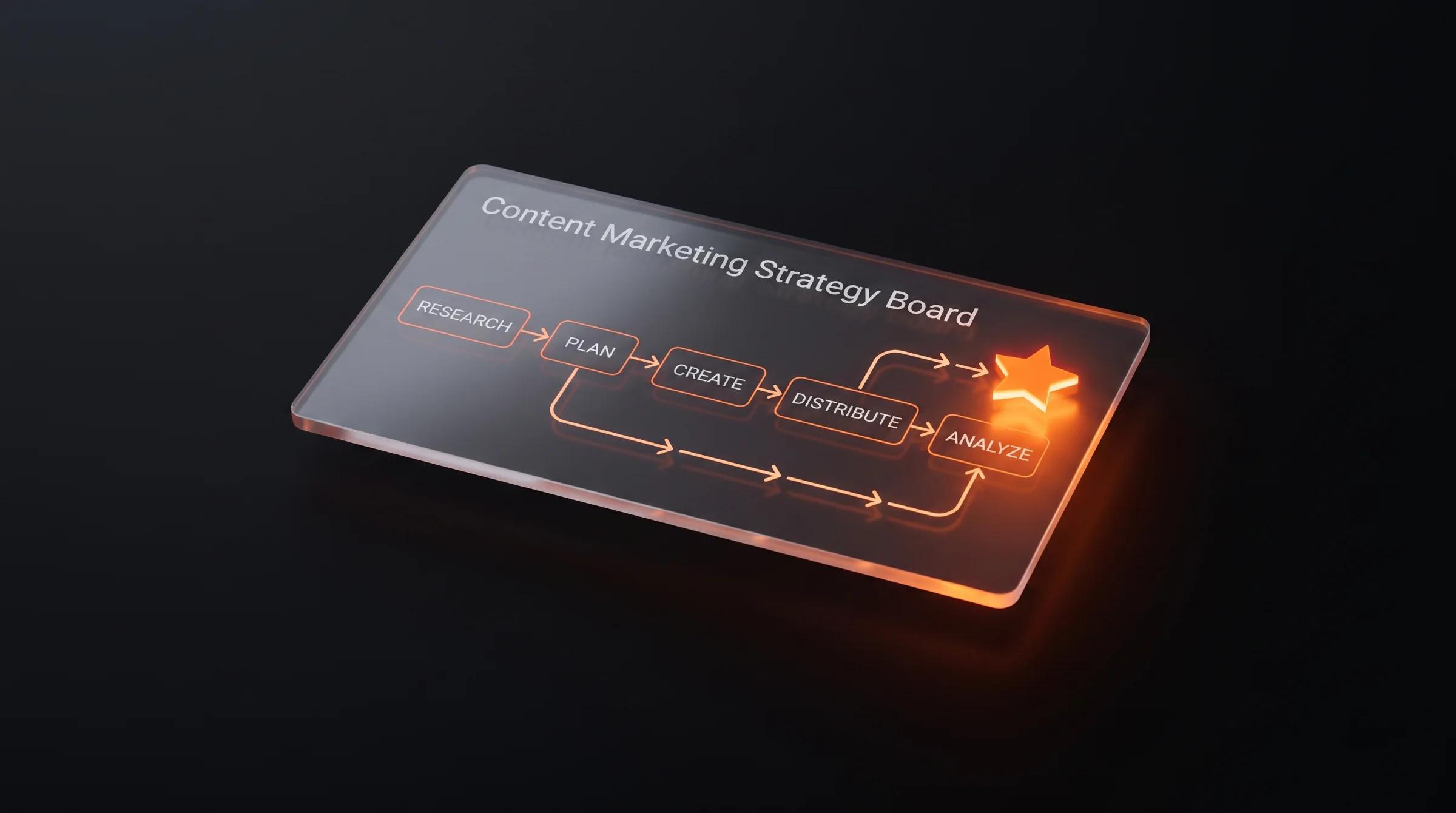
<! ANGLE: Most “content marketing tips for beginners” articles recycle 2019-era advice without acknowledging the distribution environment has completely changed. AI Overviews now capture 60%+ of searches without a click, 97% of content marketers use AI, and 96% have adopted AI into their workflow. My article pairs 7 tips with what’s different about starting content marketing in 2026, backed by data from Siege Media, CMI, Typeface, Forbes, and Orbit Media. >
TL;DR
- Content marketing generates 3x more leads than outbound at 62% lower cost, per Demand Metric [1], but beginners who try publishing everywhere at once burn out before seeing results.
- Over 60% of Google searches now end without a click, and AI search traffic surged 527% year over year [2], meaning the “publish and pray” SEO approach is dead for newcomers.
- 97% of content marketers now use AI tools [3], but the data is clear: marketers who let AI write full drafts underperform, while those who use AI for research and editing dramatically outperform peers.
- The 7 tips below use a framework I call the One-One-One Start: pick one channel, one format, and one audience before expanding. Concentration beats spread every time.
I got content marketing wrong for my first six months. I had a blog I updated whenever I remembered, a YouTube channel with three videos, a LinkedIn presence that was mostly me liking other people’s posts, and a newsletter with 11 subscribers (four were family). Every platform got a little attention. Nothing got enough. The whole thing collapsed in month seven.
I keep watching beginners repeat this exact mistake, and the punishment for getting it wrong has gotten much worse. Zero-click search now swallows the majority of Google queries. AI Overviews appear on 88% of informational searches [4]. The internet is flooded with AI-generated content nobody asked for. You can’t just publish and wait for Google anymore. Google, increasingly, delivers answers without sending anyone anywhere.
Here are 7 tips for how content marketing actually works in 2026. Each one comes with something you can act on this week.
Tip 1: Pick One Channel, One Format, One Audience (The “One-One-One Start”)
The biggest mistake beginners make is spreading across five platforms before they’re competent at any of them.
I watch this constantly. A founder launches a blog, starts a podcast, opens a TikTok account, fires up a LinkedIn newsletter, and writes an email sequence - all in the same month. Six weeks later everything is abandoned because nothing “worked.”
The One-One-One Start means choosing one distribution channel, one content format, and one clearly defined audience before touching anything else. The Siege Media 2026 survey found that 97% of marketers now rate their content program as successful, up from 73% in 2025, and 27% call it “very successful” - more than double the 11% from last year [3]. The common thread? High performers focus deeply on fewer formats.
Write your One-One-One on a sticky note: “I publish [format] on [channel] for [audience].” Don’t add a second channel until you’ve shipped consistently for 90 days with at least one measurable result.
Tip 2: Write for Answers, Not Just Rankings
Three years ago this advice would’ve sounded bizarre. Rank number one and the traffic pours in, right?
Not anymore. Ahrefs found AI Overviews reduce the organic click-through rate for the top-position result by 58% [5]. The page at position one gets roughly half the clicks it used to when an AI Overview sits above it. And 60% of all Google searches now end with zero clicks [2]. The searcher gets their answer and never visits a website.
This is where Generative Engine Optimization (GEO) comes in - structuring content so AI engines like ChatGPT, Perplexity, and Google’s AI Overviews extract, cite, and direct users your way. Siege Media found 43% of marketers now call this GEO, while 44% still say “SEO for AI” [3]. YouTube overtook Reddit as the top-cited source in AI-generated answers in early 2026 [6], proving format choice matters for LLM citations.
What GEO looks like:
- Lead every section with the answer. If your H2 asks a question, the next sentence answers it in one or two lines. Then elaborate.
- Write standalone paragraphs. AI engines scrape individual passages. If your best sentence needs three paragraphs of context, it won’t get cited.
- Use structured formats generously. Tables, numbered lists, and bolded term-definition pairs - AI parsers extract these effortlessly.
This doesn’t replace SEO. It layers on top. You’re optimizing for the algorithm and the AI summary simultaneously.
Tip 3: Use AI as Your Research Assistant and Editor, Never Your Ghostwriter
I held out against AI tools too long. When I finally started, I used them wrong - asking ChatGPT to write full drafts from scratch. The output was fine. It was also completely generic.
The data backs this up. Orbit Media found 95% of bloggers now use AI [7], but marketers who use AI to write complete articles are less likely to report strong results than average. Those who use AI for research and editing consistently outperform.
Siege Media’s 2026 survey adds detail: only 1% of marketers say their work is 100% AI-generated. Most (48%) use AI in 11-40% of their work. The top use case shifted dramatically - 74% now use AI for ideation, while the percentage using AI to draft content fell from 57% to 44% year over year [3]. People learned.
How to actually use AI as a beginner:
| AI Task | Good for Beginners? | Why |
|---|---|---|
| Topic ideation and brainstorming | Yes | Removes blank-page panic without hurting quality |
| Outlining articles | Yes | Saves 30 minutes of staring at a cursor |
| Writing full first drafts | No | Output lacks original perspective and underperforms |
| Editing YOUR draft for clarity | Yes | Catches weak transitions and bloated sentences |
| Factual research | No | AI hallucinates sources; proprietary data drives real conversion rates [4] |
| Repurposing content into new formats | Yes | Turn a blog post into 3 social posts in 90 seconds |
Typeface’s 2026 data shows non-AI blog creation dropped from 65% to 5% in two years, and 86% of marketers are increasing proprietary research budgets [4]. Original data is the moat. AI can’t replicate your customer survey results or three years of hands-on experience.
“AI is prone to hallucinations and can make major factual errors. Until AI can avoid basic errors, knowing when and how to use LLMs is what separates the high performers.”
- Siege Media, 2026 Content Marketing Trends Report [3]
Tip 4: Distribution Is Not Step Four - It’s the Whole Strategy
I used to spend 90% of my time creating and 10% distributing. The results: good articles nobody read.
Content distribution is actively putting published content in front of your target audience through email, social media, communities, and paid channels. When you have zero domain authority, no email list, and no following, your content won’t find anyone on its own. You have to carry it to them.
Beginner distribution checklist after you publish:
- Extract 3 standalone social posts. One surprising stat, one contrarian opinion, one actionable tip. Post as native content. Don’t link-drop and leave.
- Email your list. Even if it’s 40 people. Email delivers $36-$42 for every $1 spent - a 3,600% to 4,200% ROI [8]. A small list that trusts you outperforms any algorithm.
- Share in 2 communities where your audience hangs out. A Slack group, subreddit, Discord. Not as spam. As a genuine contribution.
- DM 3 people who’d find the content useful. This doesn’t scale and that’s the point. Year-one relationships beat year-three growth hacks.
Tip 5: Define Content Marketing for YOUR Business Before Copying Someone Else
Content marketing is creating valuable, relevant content to attract and retain an audience - ultimately driving profitable customer action. But what it looks like varies completely by business type.
I’ve watched beginners copy HubSpot’s enterprise playbook as solo operators with no budget. I’ve seen local businesses replicate DTC TikTok strategies when their customers find them via Google Maps. It fails because the audience, buying cycle, and trust signals don’t match.
Forbes Advisor’s 2026 guide quotes Joe Pulizzi on the shift: “People don’t want to follow brands. They want to follow individuals” [9]. CMI’s 42-expert trends report reinforces this - brands should build “trust ecosystems” around real experts rather than faceless corporate bylines [10].
Before creating a single piece, answer three questions:
What’s the one business outcome this content needs to support? Pick one: awareness, leads, sales enablement, or retention.
Who is the specific person you’re reaching? Not a demographic. A real person with a job title and problems they Google at 10 p.m.
What do you know from experience that most content on this topic doesn’t include? This is your angle. Without it, you’re adding noise to a channel that already produces 7.5 million blog posts daily [11].
Tip 6: Measure One Number Per Quarter. Add Complexity Later.
Analytics paralysis kills more beginner content programs than bad writing ever could. You open Google Analytics, stare at 47 metrics, and freeze.
Orbit Media consistently finds that bloggers who check analytics regularly report stronger results than those who never check [7]. But measuring everything on day one is worse than measuring nothing.
| Stage | Your One Metric | Why |
|---|---|---|
| Months 1-3 | Publishing consistency | You can’t optimize what doesn’t exist |
| Months 4-6 | Engagement rate on primary channel | Proves content resonates with real people |
| Months 7-9 | Email subscribers or lead captures | Connects content to a business outcome |
| Months 10-12 | Revenue or pipeline from content | The metric that justifies the whole program |
Notice what’s missing from months 1-3: traffic, rankings, follower count. Those are lagging indicators. They arrive if your content is good and distribution consistent. Obsessing over them in month two makes you quit.
Tip 7: Build Long-Term Assets While Shipping Short-Term Wins
Content marketing is not fast. But you can build for the long game while creating short-term results. They’re not mutually exclusive.
The long game is your blog, email list, and evergreen content that compounds. 61% of B2B marketers are increasing content spend in 2026, prioritizing AI tools, events, and owned media [4]. These are the same assets you can start building today for nearly nothing.
The short game is the LinkedIn post that gets 30 comments this week. The email driving 2 demo requests. The repurposed thread someone screenshots and shares. These wins keep you motivated while the long-term assets mature.
Think of it as planting an orchard while keeping a vegetable garden. The orchard (SEO content, email list, topical authority) takes years to fruit. The garden (social posts, community engagement, outreach) feeds you this season. Most beginners do only one and either burn out waiting or build nothing that lasts.
“Content marketing in 2026 rewards depth over breadth, authenticity over polish, and direct relationships over platform dependence.”
- Averi AI, 2026 Content Marketing Trends Report [12]
Frequently Asked Questions
How much does content marketing cost for a small business?
From $0 in direct spend (your own time) to $2,000-$10,000+ monthly for agencies. Siege Media’s survey shows 31% of marketers budget $15,000-$45,000 per month, while 25% spend under $5,000 [3]. Start by investing your own time on one channel for 90 days. Prove the concept works, then invest money to scale.
How long does content marketing take to show results?
Realistically, 6-12 months for measurable business results. Blog posts need 3-6 months for search traction. Successful beginners measure leading indicators (consistency, engagement, subscriber growth) while lagging indicators (traffic, revenue) build.
Is content marketing still worth it with AI Overviews eating clicks?
Yes. Content marketing generates value beyond Google traffic - it builds email lists, powers social feeds, and establishes authority in AI-powered search engines. The majority of marketers now budget up to $500 monthly for LLM tracking tools [3]. The pipe changed shape. The principle hasn’t budged.
Should beginners use AI for content marketing?
Yes, as an assistant. Non-AI blog creation dropped from 65% to 5% in two years [4]. But AI-drafted content underperforms human-led content with AI editing. Use AI for ideation, research, outlining, and editing. Write the core yourself.
Actually Start
The tip that matters more than all seven combined: publish something this week.
Not next month. Not after the perfect editorial calendar. Not after three more strategy articles. This week.
The beginners who win aren’t the ones with elegant strategy docs. They shipped something imperfect on Tuesday and learned by Friday.
If you want help building a content engine that drives results - and you’d rather skip the 18-month trial-and-error - LoudScale does this work daily for growing businesses. See our content strategy approach or browse case studies.
Now pick your channel, your format, your audience. Publish.
Sources
- Demand Metric - Content Marketing Infographic / Content Marketing Institute - 9 Stats That Prove Content Marketing Works
- ClickVision - 50+ Zero Click Search Statistics for 2026 / Heroic Rankings - Google AI Overview Statistics 2026
- Siege Media - 7 Content Marketing Trends Shaping 2026
- Typeface - 50+ Content Marketing Statistics to Watch [2026]
- Ahrefs - AI Overviews Reduce Clicks Update
- eMarketer - FAQ: Content Marketing in 2026
- Orbit Media - Annual Blogger Survey / Blogging Statistics
- Forbes Advisor - Email Marketing Statistics 2026
- Forbes Advisor - Content Marketing: Ultimate Guide for 2026
- Content Marketing Institute - 42 Experts Name Top Trends for 2026
- Backlinko - Blogging Statistics for 2026
- Averi AI - 10 Content Marketing Trends Defining 2026
- Website Growth GraderFlagship free growth grade score before email.
- SEO Checker40+ live HTML checks on any public URL.
- AI Visibility ReadinessAnswer-engine readiness and extractability.
Diagnostics show a useful score before email. Explore LoudScale services when you want a full plan and implementation.

LoudScale Team
Growth Marketing Specialists
The LoudScale team shares practical strategies and experiments across search and AI visibility, content authority, B2B lead generation, lifecycle systems, analytics, and responsible AI.