<! ANGLE: Content brief advice everywhere tells you to list audience, keywords, and word count. Nobody addresses the two reasons briefs fail in mid-2026: (1) Google’s March 2026 core update made Information Gain the dominant ranking signal - if your brief doesn’t require original data, you’re briefing content that can’t rank, and (2) 94% of marketers now use AI to draft, meaning the brief is the ONLY place strategy enters the content. This piece bridges both gaps. >
TL;DR
- Poor briefs waste 33% of global marketing budgets - an estimated $429 billion in 2026 [1]. Most briefs describe the container (word count, keywords) instead of the strategic reasoning behind it.
- Google’s March 2026 core update made Information Gain the dominant ranking signal: pages with proprietary data gained 15-25% visibility. Templated content dropped 30-50% [2]. Your brief now has to demand originality, not just completeness.
- The BetterBriefs Project surveyed 1,034 marketers across 54 countries. 79% of marketers think they write good briefs. Only 6% of agencies agree [3].
- In 2026, 74.2% of new webpages contain AI-generated content [4]. Content briefs are the highest-leverage document in your operation because the brief is the only place strategy enters before AI starts drafting.
I scrapped our content brief process in March 2026. Not because it was broken - it had every section the templates recommend. Keywords, word count, audience, H2 suggestions, competitor links.
But our first-draft acceptance rate stayed stuck at about 35%. Seven out of ten drafts needed heavy rework. The writers weren’t the problem. They followed the brief exactly. The brief was the problem.
After we rebuilt how we brief content, our acceptance rate jumped to roughly 70%. Same writers. Same topics. Radically different brief. Here’s exactly what changed - and why these changes matter more than ever now that Google actively punishes content that brings nothing new.
Why do most content briefs fail?
They confuse completeness with strategy.
The BetterBriefs Project surveyed nearly a thousand marketers and agency professionals across 54 countries. The gap was staggering: 78% of marketers believed their briefs provided clear strategic direction. Only 5% of agencies agreed [3]. That’s not a communication gap. That’s two groups living in different realities.
Also: 9 out of 10 marketers admit their briefs change after content has already been briefed in [3]. If your briefs almost always change, the initial version wasn’t communicating strategy. It was communicating a work order.
The cost? BetterBriefs estimates 33% of marketing budgets go to waste from poor briefs and misdirected work. With global ad spend projected at $1.3 trillion in 2026, that’s $429 billion evaporating [1]. On a $100K content budget, that’s $33,000 in revision emails.
The root cause: most briefs answer WHAT (write a 2,200-word article on X) without answering WHY (here’s the strategic reason, the specific gap, the tradeoff hierarchy).
“Briefs should direct and inspire, not confuse and frustrate. Our results demonstrate the sad reality of the current state of the industry.” - Matt Davies and Pieter-Paul von Weiler, Co-founders of BetterBriefs [1]
The “Decision Layer” framework
Think of a content brief as having two layers. Most teams build only one.
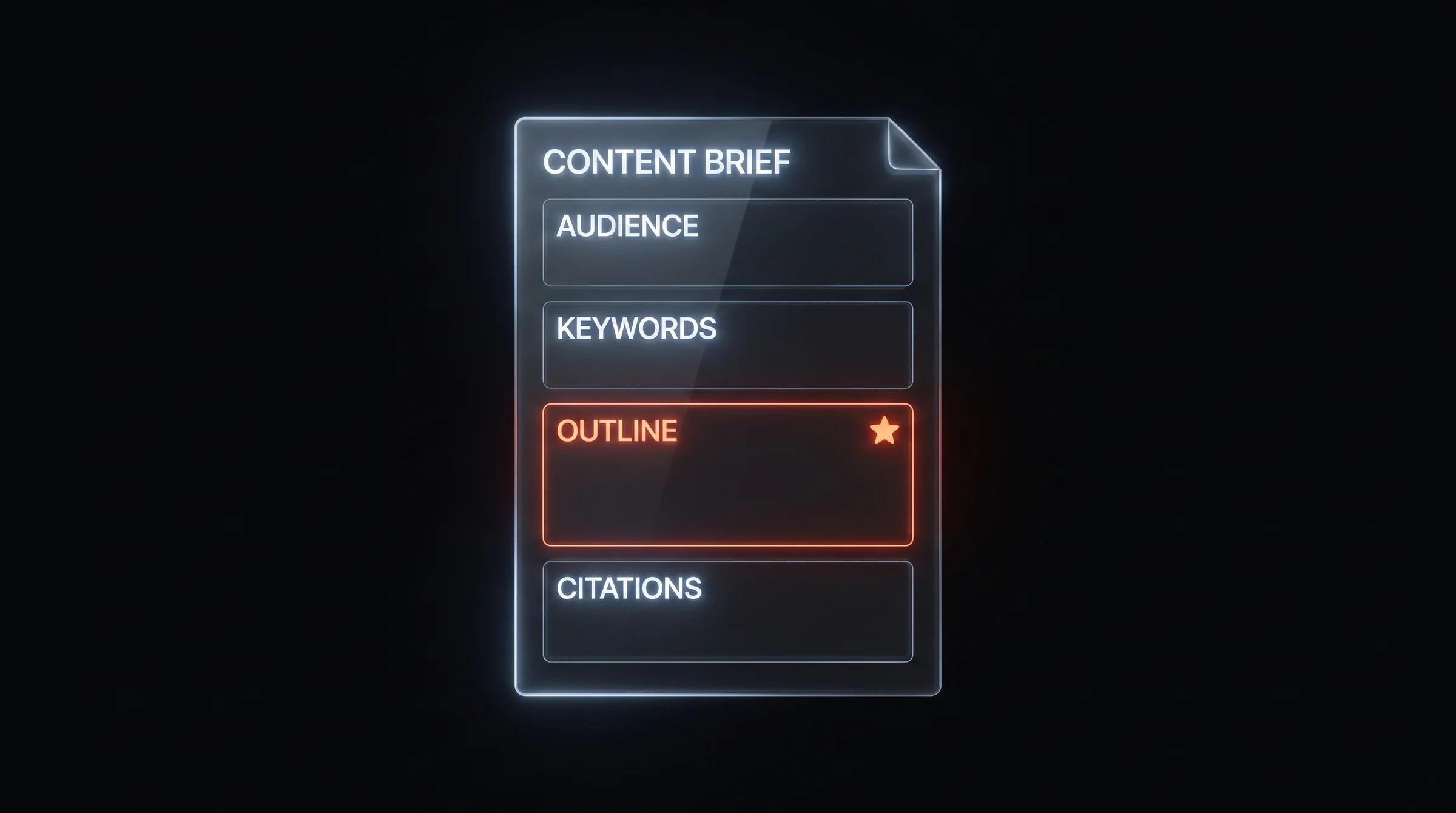
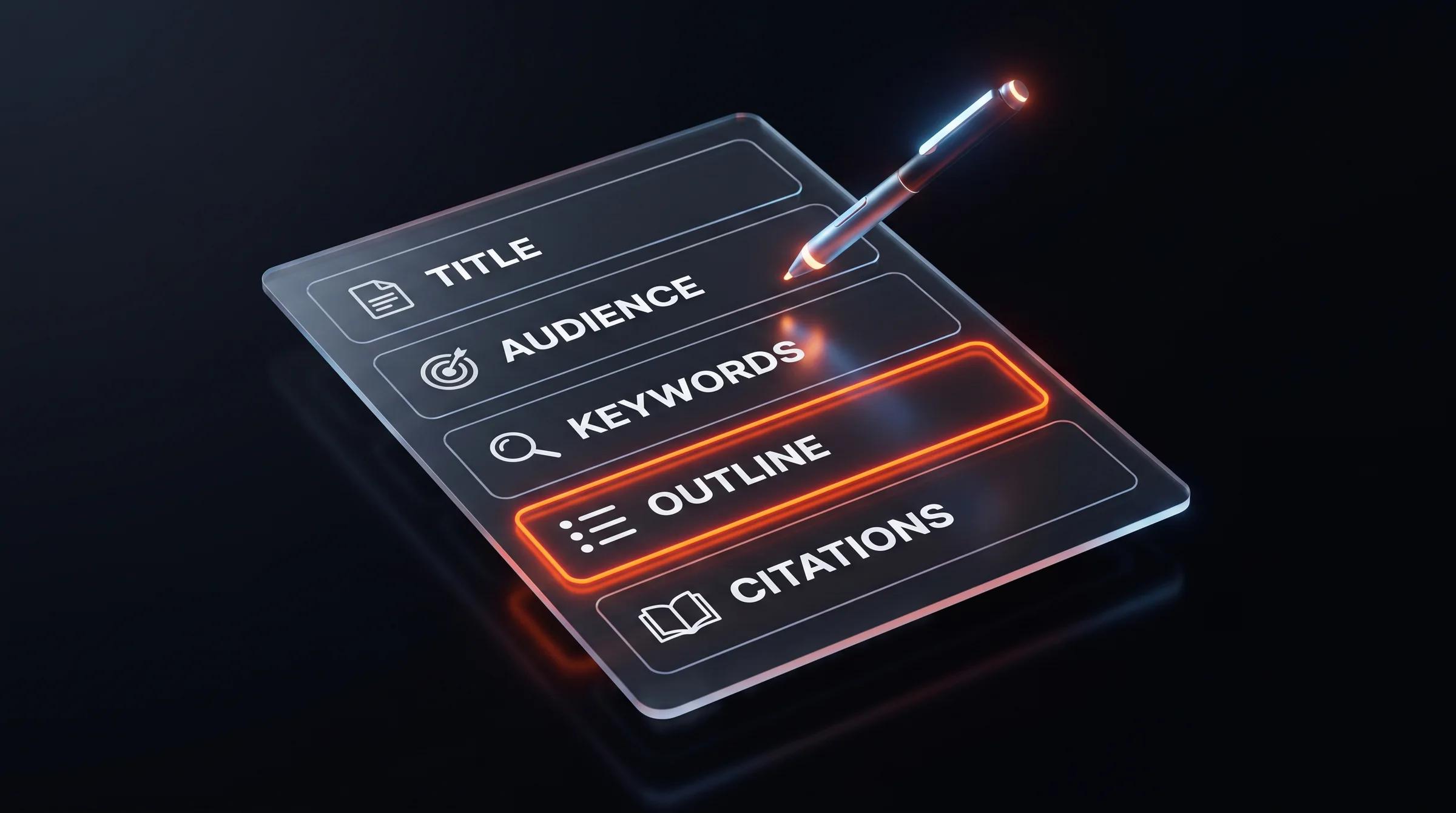
Layer 1 - The Specification Layer: keyword targets, audience, word count, headers, links. Necessary. Not sufficient.
Layer 2 - The Decision Layer: the strategic reasoning behind every specification. Why this content exists. What gap it fills. What tradeoffs to make.
Here’s what belongs in the Decision Layer:
-
The “why now” statement. One or two sentences explaining why this piece needs to exist today. Not “it’s on the calendar.” Something specific. “This keyword is trending up 55% month-over-month and all top results use 2024 benchmarks.”
-
The angle. What does this article say that the top five results don’t? If you can’t answer this in one sentence, you’re not ready to brief it. Post-March-2026 core update, this is no longer optional. It’s the baseline requirement for ranking.
-
The reader’s before-and-after state. Before reading, they believe/know X. After reading, they believe/know Y. This one exercise prevents more forgettable content than any keyword optimization.
-
Tradeoff guidance. Depth or breadth? Technical accuracy or readability? Timeliness or evergreen? Writers instinctively make these calls. Tell them which way to lean.
-
The exclusion statement. What NOT to cover is often more useful than what to include. “Not a beginner’s guide. Don’t explain what SEO is. Our reader already knows.”
| Brief Element | Specification Layer (WHAT) | Decision Layer (WHY) |
|---|---|---|
| Target keyword | “content brief template” | “We’re targeting this because current results focus on downloadable templates, not process. We can win with a how-to-think piece that includes our original revision-rate data.” |
| Word count | 2,000-2,200 words | “Competing articles average 2,500. We’re going shorter and denser because the top result pads with filler.” |
| Audience | “Content marketers, mid-level” | “They’ve written briefs before. They’re frustrated that writers miss the mark. Write like you’re explaining this to a colleague who’s had three bad freelancer experiences this quarter.” |
| Tone | “Conversational, authoritative” | “Same tone as our top-performing [internal link placeholder: LoudScale content strategy guide]. Short sentences. First person. No throat-clearing intros.” |
The left column hands out instructions. The right column hands over understanding. A writer with understanding always produces better work than a writer with instructions. Google’s March 2026 update proved this at scale - original data and frameworks gained 15-25% visibility. Templated rewrites dropped 30-50% [2].
Building a content brief from scratch
I timed myself building a brief from zero last month. 50 minutes. Not two hours of template-copying. Here’s the process:
-
Start with intent classification, not keyword research. Google your keyword and study what’s ranking. How-to tutorials? Comparisons? Listicles? The format Google rewards tells you what the searcher expects. Match the intent first. Get creative second.
-
Read the top five results and catalog what’s missing. Don’t note what they include. Note what they skip. Unanswered questions, outdated statistics, vague advice, missing examples. These gaps are your angle.
-
Write the Decision Layer before touching any template fields. “Why now.” The angle. The before-and-after. If you can’t articulate these, go back to research.
-
Fill in the Specification Layer second. Keywords, H2s, internal links, competitor URLs. But each specification must trace back to a decision. A 600-word article with an original data point now outranks a 3,000-word guide that paraphrases others [2].
-
Add the anti-brief. Two to three bullet points about what this content should explicitly NOT be. “Not a beginner’s guide. Not a template download. Not a list of AI tools.”
-
Include a SERP snapshot. Screenshots or live links of the top three to five results. Costs 40 seconds. Saves the writer an hour of competitive analysis guesswork.
Pro Tip: Don’t brief content the same day you research it. Even one night between research and briefing leads to sharper angles. Your subconscious does surprisingly competent strategy work while you sleep.
Adapting your brief for AI-assisted writing
Here’s the question nobody on page one answers: what changes when AI writes your first draft?
A lot.
HubSpot’s 2026 report shows over 80% of marketers use AI for content creation [5]. Typeface found the percentage of marketers who don’t use AI for blog creation dropped from 65% to just 5% in two years [6]. Ahrefs analyzed 900,000 new webpages: 74.2% contained AI-generated content [4]. The brief-to-human-writer pipeline most advice assumes? Already a minority workflow.
The problem: AI tools excel at specifications and fail at strategy. Give an LLM your standard brief - keyword, word count, audience, headers - and it produces a perfectly mediocre article. AI optimizes for pattern-matching. The most common pattern in existing content is average.
The Decision Layer matters more now because the brief is the only place strategic thinking enters before the AI starts drafting. Here’s what I changed:
-
Add explicit information-gain instructions. Tell the AI which unique data points, benchmarks, or proprietary examples MUST appear. AI won’t invent original insights. You inject them through the brief.
-
Include voice anchors, not voice descriptions. Paste two to three paragraphs from an existing piece that nails your voice. AI mimics examples far better than it interprets adjectives like “professional yet approachable.”
-
Specify what to cut. AI drafts tend toward bloat. Include instructions like: “Remove any sentence starting with ‘It’s worth noting.’ Remove paragraphs that restate the previous paragraph. No throat-clearing intros.”
-
Flag human-only sections. Personal anecdotes, client examples, contrarian opinions, screenshots of your own data. Mark these clearly so the editor knows where to replace AI output.
| Brief Component | For Human Writers | For AI-Assisted Workflows |
|---|---|---|
| Voice guidance | “Conversational, like explaining to a peer” | Paste 2-3 sample paragraphs matching target voice |
| Angle | “Focus on the process gap most articles miss” | List 3-5 specific proprietary claims or data points that MUST appear |
| Structure | Suggested H2s with flexibility to reorganize | Exact H2 and H3 structure - AI needs more scaffolding |
| Quality control | “Flag anything you’re unsure about” | “Delete any sentence that could appear in a competitor’s article unchanged” |
The three brief mistakes costing you the most
Mistake 1: Briefing before the thinking is done. I used to brief content the moment the calendar was finalized. Terrible approach. A brief written before deep research is a brief full of assumptions. Now I research first, wait at least a day, then brief. Marketing Week’s 2025 survey found 32.5% of marketers cite brief-writing as a skills gap [7]. Part of that gap is timing.
Mistake 2: Competitor URLs without annotations. Dropping five bare URLs into a brief without context is lazy. The writer opens them - then what? They don’t know if you want to beat these pieces, borrow their structure, or avoid their approach. Annotate every link: “This ranks #1 but has zero original data. We beat them by including our survey results.”
Mistake 3: Treating the brief as one-directional. The best brief I ever received came back covered in questions. The writer found three contradictions and one section where the angle didn’t match intent. That feedback made the final piece dramatically better. Build a feedback loop. Tell writers to push back. BetterBriefs data confirms 9 out of 10 marketers say briefs change after being briefed in [3].
Watch Out: If your brief process takes more than an hour per article, something’s broken. A solid brief should take 40-55 minutes. Longer means over-researching or failing to templatize the Specification Layer. Spend brainpower on the Decision Layer - that’s the part unique every time.
Measuring whether your briefs are working
Four metrics worth tracking:
-
First-draft acceptance rate. Below 50% and your briefs are the bottleneck. After rebuilding, ours moved from 35% to roughly 70%.
-
Revision cycles per piece. Two rounds is healthy. Four or more means the brief missed something.
-
Content performance against stated objectives. If you briefed a piece to rank and it’s on page three after 90 days, the brief or the execution failed.
-
Writer satisfaction. Ask writers quarterly: “What one thing would make briefs more useful?” Ours wanted fewer keyword targets. They were drowning in secondary keywords and losing focus on the primary one.
Frequently Asked Questions
How long should a content brief be?
About one page of strategic guidance (Decision Layer) plus half a page of specifications. If it runs past two pages for a single article, you’re including unnecessary detail or micromanaging execution.
Should I use a different brief for AI vs. human writers?
Yes. AI workflows need more explicit structure - exact headers, specific data points, concrete voice samples. Human writers need more strategic context and creative latitude. The Decision Layer matters for both. The Specification Layer gets more detailed for AI.
What’s the single most important element?
The angle statement. If you can articulate what your article says that competing content doesn’t, everything falls into place. If you can’t, no keyword optimization saves the piece. Post-March-2026 update, this determines whether your content appears in search at all [2].
How often should I update my brief template?
Quarterly. Don’t overhaul monthly. The Specification Layer stays stable. The Decision Layer evolves as you learn what information writers actually use. Every quarter, look at your three worst-performing pieces and trace the failure back to the brief.
Can AI tools create content briefs for me?
AI handles roughly 60% - competitor headings, keyword gaps, PAA questions. The other 40% - the angle, the Decision Layer, the exclusion statement - needs a person who understands your business strategy. Tools compress creation from two hours to about 40 minutes. The thinking still comes from you.
The brief is the strategy
Adobe’s research found 71% of marketers expect content demand to grow 5x or more by 2027 [8]. The Content Marketing Institute calls 2026 a “discoverability crisis” as AI content floods every channel [9]. More noise. More competition for every click.
In that environment, the brief isn’t paperwork. It’s the highest-leverage document in your content operation. It’s where strategy either enters the content or doesn’t. And with Google’s March 2026 update making original data the difference between page one and page five [2], the brief now determines whether your content gets found at all.
Stop treating your brief like a form. Treat it like a strategic argument for why this piece deserves to exist. Do that, and the writing - human, AI, or both - handles itself.
If you’d rather have a team manage strategy and execution, LoudScale builds content briefs and full content pipelines for growth-focused brands. See our [internal link placeholder: LoudScale content strategy services] or [internal link placeholder: AI-assisted content workflows at LoudScale]. But the framework above gets you 80% of the way on your own.
Sources
- BetterBriefs, “The BetterBriefs Project Global Report,” betterbriefs.com, 2025. Global ad spend: WARC, Dec 2025.
- Digital Applied, “Information Gain: Google’s #1 Ranking Signal in 2026,” digitalapplied.com, Apr 18, 2026.
- K. Wong, “Survey: 79% marketers feel good about writing briefs, only 6% of agencies agree,” Marketing-Interactive, Jun 6, 2025.
- R. Law, X. Guan, T. Soulo, “74% of New Webpages Include AI Content,” Ahrefs, May 19, 2025.
- HubSpot, “2026 State of Marketing Report,” hubspot.com, 2026.
- A. Pai, “50+ Content Marketing Statistics to Watch [2026],” Typeface, Feb 6, 2026.
- C. Rogers, “Third of brands lack skills in writing agency briefs,” Marketing Week, Apr 17, 2025.
- V. Pandya, “Adobe research finds demand for content will grow 5x by 2027,” Adobe, Jun 16, 2025.
- S. Stahl, “42 Experts Reveal Top Content Marketing Trends for 2026,” Content Marketing Institute, Dec 9, 2025.
- Website Growth GraderFlagship free growth grade score before email.
- SEO Checker40+ live HTML checks on any public URL.
- AI Visibility ReadinessAnswer-engine readiness and extractability.
Diagnostics show a useful score before email. Explore LoudScale services when you want a full plan and implementation.

LoudScale Team
Growth Marketing Specialists
The LoudScale team shares practical strategies and experiments across search and AI visibility, content authority, B2B lead generation, lifecycle systems, analytics, and responsible AI.