TL;DR
- A content brief is a strategic document that aligns writers and stakeholders on goals, audience, structure, and requirements before anyone writes a word. Grab our free template at the end of this article.
- The BetterBriefs Project projects US$429 billion in global ad spend will go to waste in 2026 alone due to poor briefs - that’s $13,500 per second. 80% of marketers think they brief well. Only 10% of the people receiving those briefs agree.
- Gartner predicted a 25% drop in traditional search volume by 2026. AI Overviews now appear on 48% of queries. Most free content brief templates still ignore AEO (Answer Engine Optimization) and GEO (Generative Engine Optimization). Ours doesn’t.
- 97% of content marketers now rate their programs as successful - up from 73% in 2025. The common thread among top performers? Strategic briefs, not just more content.
I’ve spent three years watching content teams burn money. Not on bad writers. On bad briefs.
Here’s the thing that finally clicked for me: every content brief template circulating online was designed for a world where Google was the only reader. That world is gone. Your content now has three audiences - human readers, Google’s algorithm, and AI answer engines that extract and cite answers from your work. Most briefs ignore the third audience entirely.
73% of B2B marketers now have a documented content marketing strategy. Content marketing budgets consume 26% of total marketing spend. And yet - BetterBriefs found the same 80/10 perception gap persists: marketers think their briefs are great; the people executing them disagree by a margin of 8 to 1.
This article gives you three things: a diagnostic framework to identify where your briefs actually fail, a free template with the AI-era fields every other template skips, and concrete guidance on filling it out without creating a bloated document nobody reads.
Why Bad Briefs Cost More Than Bad Writing
The BetterBriefs Project’s original study found that 33% of marketing budgets went to waste due to poor briefs and misdirected work. Not bad creative. Not failed campaigns. Bad briefs (BetterBriefs, 2026). With global ad spend projected to hit $1.3 trillion in 2026, that’s US$429 billion evaporating before a single deliverable reaches an audience.
The perception gap was even wilder. 80% of marketers believe they brief well. Only 10% of agencies and freelancers agree (Contentphilic, referencing BetterBriefs). That’s not miscommunication. That’s two groups operating in completely different realities.
“A bad brief results in wasted time, money and patience all round. You can’t produce good work without a good evidence-based brief.”
- BetterBriefs Project research, as covered by the IPA
Here’s what that means in practice. If your content budget is $120,000 a year, roughly $40,000 disappears before anything hits publish. The bigger your content operation, the bigger the waste. Scale doesn’t fix bad process. It amplifies it.
Contentphilic reports cutting their average revision cycles by 50% just by improving how briefs are collected and structured. Many of their projects needed zero revisions after the fix. Zero. If you’re running three or four rounds of edits on every article, your brief is the bottleneck, not your writer.
The Brief Breakdown Matrix: Diagnose Before You Download
Before you grab another template, stop. I’ve watched teams adopt shiny new templates and see zero improvement because the template wasn’t the problem. The problem was a specific failure point they never identified.
After auditing dozens of content workflows, I’ve mapped brief failures into four types. I call this the Brief Breakdown Matrix. Figure out which quadrant you’re in before you change anything.
| Failure Type | Symptoms | Root Cause | Fix Priority |
|---|---|---|---|
| Strategic Void | Content publishes but drives no traffic, leads, or measurable action. Writers report they “didn’t know the goal.” | Brief lists keywords but skips business objectives and search intent. | Map goal and intent before keyword selection. |
| Audience Blindness | First drafts sound generic. Tone is off. Examples don’t resonate. Two or more rewrites needed. | Brief says “marketing professionals” instead of “solo B2B marketers at companies under 50 people who report to a non-marketing CEO.” | Add a 2-3 sentence audience pain-point section with behavioral context. |
| Structure Chaos | Writer delivers content that doesn’t match what you pictured. Sections are misplaced. Key topics missing. | Brief provides a topic but no outline, or provides an outline with no reasoning behind structure choices. | Add H2/H3 wireframe with one-line explanations of what each section should accomplish. |
| Technical Afterthought | Content reads well but doesn’t rank. Missing meta descriptions, internal links, schema, or AEO structure. | Technical SEO and AI-visibility requirements get bolted on after the draft instead of built into the brief. | Integrate AEO/GEO and technical fields into the brief so they’re impossible to skip. |
Most teams have multiple problems. But one is usually causing 70% of the damage. Identify that one and fix it first.
If your drafts are well-written but nobody reads them, you’re in the Strategic Void. If your drafts miss the mark tonally, that’s Audience Blindness. If you keep restructuring final drafts, that’s Structure Chaos. And if content is strong but invisible in both Google and AI engines, that’s the Technical Afterthought.
45% of Fortune 1000 companies now have dedicated AEO programs. They’re already solving the Technical Afterthought. Your competitors aren’t waiting.
The 12 Non-Negotiable Brief Fields
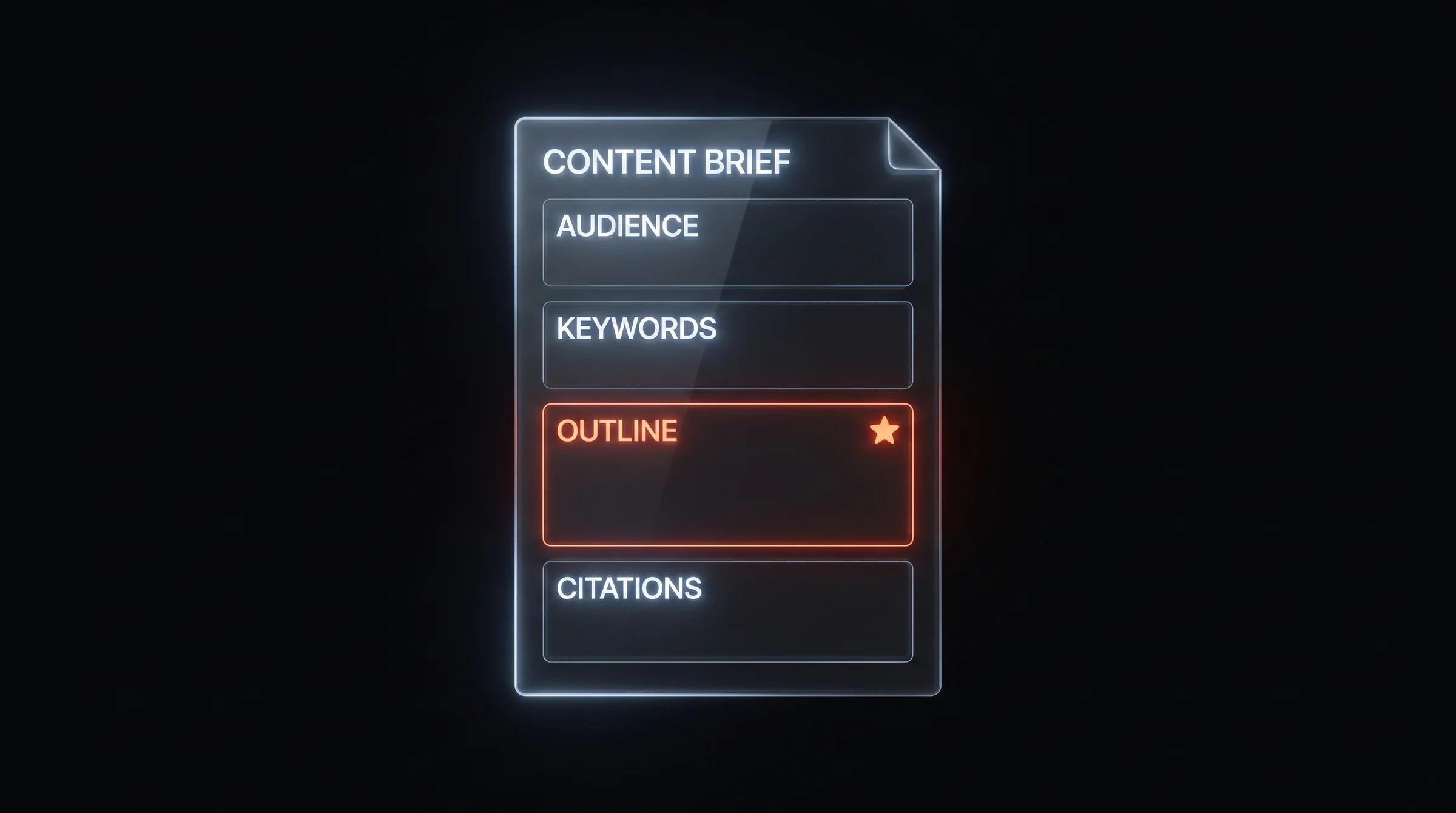
A content brief needs to be comprehensive enough to prevent misalignment but short enough that people actually use it. I’ve seen 12-page templates that gather dust. I’ve seen one-paragraph briefs that produce garbage. The sweet spot is one to two pages.
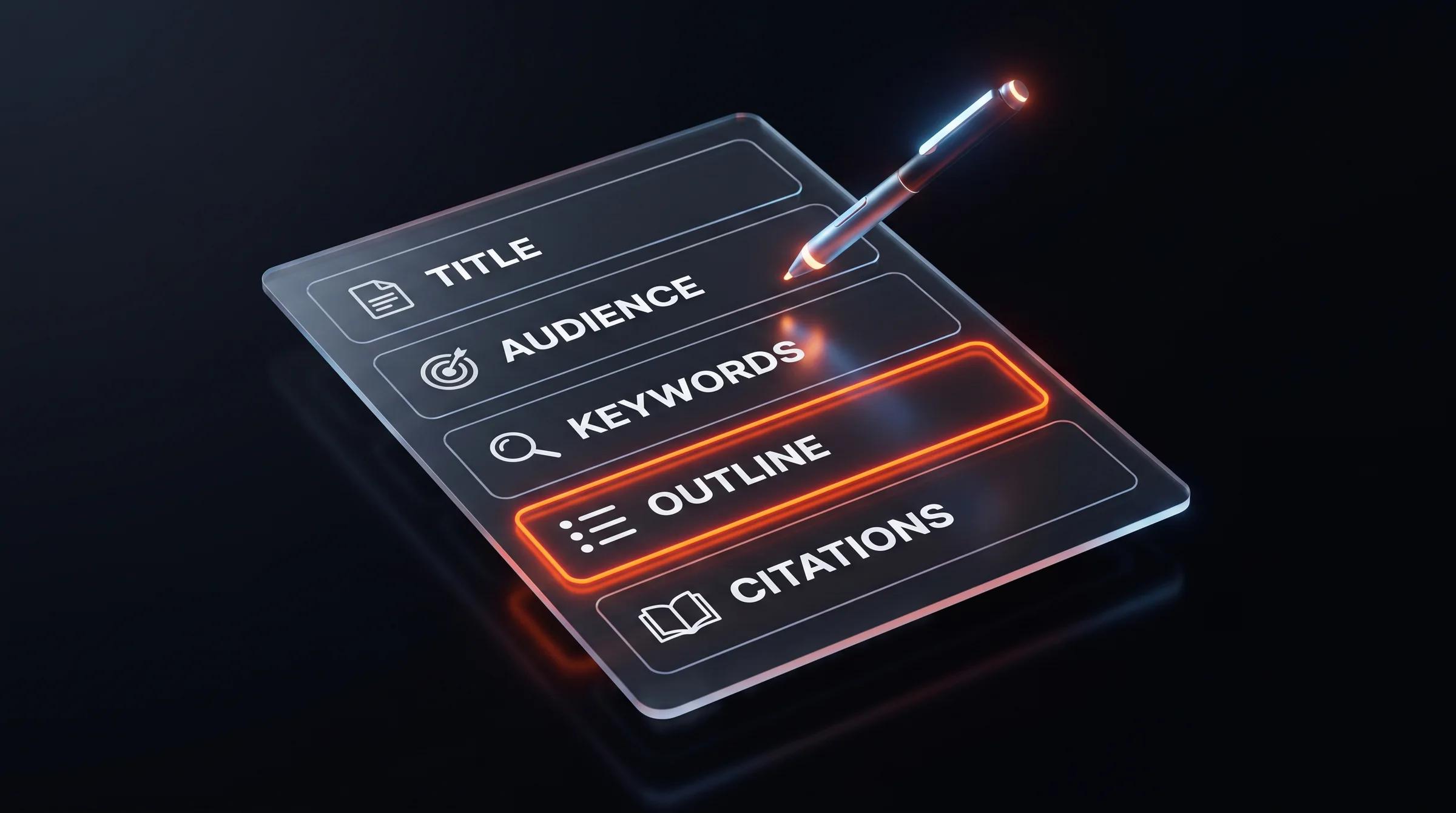
Here are the fields every content brief should include, organized by the order you should fill them out:
-
Working title with primary keyword. State the content type (blog post, landing page, comparison article). Start with the keyword in the working title. The writer can refine it later, but anchoring on the keyword keeps everyone honest.
-
Business objective. One specific sentence. “Generate 50 qualified demo signups from mid-market SaaS marketing leaders” is actionable. “Create awareness” is not. If you can’t name a specific outcome, the content has no business existing.
-
Target audience and pain points. Go beyond demographics. Name the role, the company size, the specific frustration. “Content managers at agencies with 10-50 employees who are tired of rewriting freelancer drafts” tells a writer everything they need in one sentence.
-
Primary and secondary keywords with intent mapping. Don’t just list keywords. Attach a one-line intent description to each. “Content brief template (intent: user wants a free, downloadable, ready-to-use template)” vs. “how to write a content brief (intent: user wants step-by-step instructions, likely a beginner).”
-
Competitor references with gap notes. Link to 2-3 top-ranking articles. Note what they do well. Note what they skip. This is where writers find their angle, not just their topic.
-
Outline with section-level goals. Provide H2s and H3s, but more importantly, explain what each section needs to accomplish. “H2: Why briefs matter. Goal: create urgency with specific data so the reader continues.”
-
Internal and external link targets. Be specific. Provide the URLs and suggested anchor text. Writers shouldn’t guess which pages matter most to your internal linking strategy.
-
Word count range. Give a range, not a single number. “1,500-2,000 words” gives the writer room to match the depth the topic actually requires instead of padding or cutting to hit an arbitrary target.
-
Brand voice and tone notes. Two sentences minimum. “Conversational, direct, slightly opinionated. Think smart colleague, not textbook professor.” Link to your style guide if you have one.
-
Call to action. What should the reader do next? Be precise. “Sign up for the free plan” outperforms “convert.”
-
Deadline and review process. Draft date, final date, reviewer name, turnaround time. Ambiguity here creates the bottlenecks most teams blame on “writers being slow.”
-
AEO/GEO requirements. This is the field category nobody else includes. See the next section.
Rule of thumb: Fill out items 1-3 before touching a keyword tool. Strategic clarity drives keyword selection, not the other way around. I’ve watched teams pick a keyword first and then struggle to reverse-engineer a business reason for writing about it. That’s backwards.
The Fields Every Other Template Skips: AEO and GEO Briefing
Here’s where I take issue with every free content brief template I’ve audited. They’re optimized for 2019.
Answer Engine Optimization (AEO) is structuring content so AI platforms like ChatGPT, Perplexity, and Google AI Overviews can extract and cite direct answers from it. Generative Engine Optimization (GEO) is the broader strategy of making your content visible across AI-powered search interfaces. Exactly zero of the free content brief templates on page one include dedicated fields for either.
That’s a growing liability. AI Overviews now appear on 48% of all Google queries - a 58% YoY increase from 31% (BrightEdge, February 2026). Gartner’s 2024 prediction that traditional search volume would decline 25% by 2026 has effectively materialized. And AI Overviews don’t just list blue links. They pull specific passages, cite specific sources, and serve them as direct answers. If your content isn’t structured for extraction, it doesn’t get cited.
Here are the AEO/GEO fields I now include in every content brief:
| AEO/GEO Brief Field | What It Does | Example |
|---|---|---|
| Definition Blocks | Instructs writer to provide bold-term definitions in one self-contained sentence that AI engines can extract as standalone answers. | “Include a one-sentence definition of ‘content brief’ in the intro paragraph.” |
| FAQ Targets | Lists 3-5 specific questions the content must answer with self-contained, 40-60 word responses. AI systems pull FAQ answers for zero-click SERP features and citation. | “What is a content brief? How long should a content brief be?” |
| Entity References | Names the people, organizations, tools, and concepts that should be mentioned to build topical authority signals across knowledge graphs. | “Reference BetterBriefs Project, Gartner, Contentphilic, Clearscope.” |
| Self-Contained Answer Blocks | Marks sections where every sentence must make sense if extracted alone - no “this,” “that,” or “it” references to prior paragraphs. | “The comparison section must be fully readable without surrounding context.” |
| Schema Direction | Specifies which structured data types to implement (Article, FAQPage, HowTo, Organization). | “Add FAQPage schema for the FAQ section.” |
| Source Citation Style | Instructs writer to embed sources as inline links with descriptive anchor text so AI engines can trace claims to credible origins. | “Link statistics to original source URLs, not roundup blog posts.” |
| Freshness Directive | Sets specific recency requirements. 65% of AI bot hits target content published within the past year (Seer Interactive, referenced by The Digital Bloom). | “All statistics must be from 2025-2026. Source public research, not old blog posts.” |
How Detailed Should Your Brief Be?
This question comes up in every content team conversation I’ve been part of. Too detailed and the brief takes longer than writing the article. Too sparse and the first draft is useless.
I use a framework based on two variables: content complexity and writer familiarity.
New freelancers on their first assignment. Full outline with H2s, H3s, section-level goals, competitor gap notes, tone examples from existing content, and specific no-go warnings. This brief runs 1.5 to 2 pages. It takes me 30-45 minutes to create. It saves 2-3 hours of revisions.
Experienced writers who’ve done 5+ pieces for you. Working title, business goal, audience, keywords with intent, a rough H2 outline, and the AEO fields. About one page. 15-20 minutes to create. These writers have internalized the voice and can make structural calls independently.
Subject matter experts writing their own content (founders, execs, in-house practitioners). I flip the brief. I don’t tell them what to write. I tell them what not to write. “Don’t rehash what competitors already cover. Here are the three gaps we identified. Hit those.” Then I provide the technical SEO and AEO fields as a separate checklist they fill in after drafting. SMEs write best when you remove constraints on their expertise and add constraints on the mechanical stuff.
Watch Out: The biggest brief mistake isn’t a missing field. It’s including fields that nobody ever fills out. Every blank field trains your team to skip fields. If a section gets left empty repeatedly, either make it required with a default value or delete it. Half-used templates train teams to produce half-read briefs.
The Template (Free, Ready to Use)
Copy this into Google Docs, Notion, or whatever tool your team lives in. I’ve stripped out decoration and kept only what’s functional.
Section 1: Strategic Foundation
- Working Title: [Primary keyword + specific angle]
- Content Type: [Blog post / Landing page / Comparison / How-to / Other]
- Business Objective: [One sentence: what measurable action should this content drive?]
- Target Audience: [Role, company type, experience level, specific frustration]
- Funnel Stage: [Awareness / Consideration / Decision]
Section 2: SEO Direction
- Primary Keyword: [Keyword + monthly search volume + intent type]
- Secondary Keywords: [3-5 related terms with intent notes for each]
- Competitor Articles to Beat: [2-3 URLs + one-line gap analysis for each]
- Internal Links: [URLs + suggested anchor text]
- External Link Guidance: [Source quality thresholds + any required references]
Section 3: Content Structure
- Outline: [H2s and H3s with one-line section goals for each]
- Required Elements: [Tables, lists, blockquotes, images, statistics, original examples]
- Word Count Range: [Min - Max]
- CTA: [Specific action + suggested placement]
Section 4: AEO/GEO Requirements [The section nobody else includes]
- Definition Blocks: [Terms that need one-sentence, extractable definitions]
- FAQ Targets: [3-5 questions with self-contained answers required]
- Entity References: [People, brands, tools to name for topical authority]
- Schema Type: [Article / FAQPage / HowTo / Other]
- Self-Contained Passage Check: [Sections that must make sense extracted alone]
- Freshness Directive: [Earliest acceptable source date for statistics quoted]
Section 5: Voice and Delivery
- Tone Notes: [2-3 sentences or link to style guide]
- Things to Avoid: [Topics, phrases, competitors not to mention]
- Deadline: [Draft date + final date]
- Reviewer: [Name and feedback turnaround time]
That’s the template. One page for experienced writers. Two pages for new ones. No filler.
Why AI Made Briefs More Critical, Not Less
Here’s the take that gets me pushback. Most teams assume AI tools make content briefs redundant. “Just prompt ChatGPT.” I think the reverse is true.
97% of content marketers now plan to use AI in their 2026 workflows, up from 90% in 2025 and 83% in 2024 (Siege Media). But here’s what nobody talks about: 68% of marketers say quality and differentiation are their greatest challenge (HubSpot, State of Marketing 2026). AI is making it easier to produce content. It’s also making it harder to produce content that stands out.
B2B content marketing now generates 3x more leads than outbound at 62% lower cost - but only for teams with documented strategy. Teams without strategy produce content. Teams with strategy produce results. The gap is widening.
A strong brief is the differentiation engine. It says: “Here’s the angle nobody else has taken. Here’s the specific audience. Here’s the data point nobody else cited. Here’s the structural format AI engines require for citation.” Without a brief, AI-assisted content sounds like everyone else’s AI-assisted content. With one, it sounds like your content.
Only 22% of B2B marketers rate their content marketing as very or extremely successful, according to the Content Marketing Institute’s 2026 research. The successful 22% disproportionately use structured briefs. The remaining 78% are guessing.
Frequently Asked Questions
What is a content brief?
A content brief is a strategic planning document outlining the goals, audience, keywords, structure, tone, and technical requirements for a specific piece of content before writing begins. It aligns writers with business objectives and cuts revision rounds by providing a shared definition of done. Effective briefs run one to two pages and take 15-45 minutes to create depending on complexity.
How long should a content brief be?
Most effective content briefs are one to two pages. Briefs longer than two pages go unread. Briefs shorter than half a page leave too many decisions to the writer. Length depends on writer experience: new freelancers need closer to two pages with full outlines and tone examples. Experienced team members can work from one-page briefs focused on strategy and SEO fields.
What’s the difference between a content brief and a creative brief?
A content brief targets a single content asset (blog post, landing page, article) and includes keywords, search intent, content structure, and SEO requirements. A creative brief is broader - used for campaigns spanning multiple formats (design, video, ads) - and focuses on messaging, visual direction, and campaign objectives. Content briefs are more tactical and asset-specific.
Should I include AI-specific fields in my content brief?
Yes. Content briefs in 2026 need AEO and GEO fields: definition blocks for one-sentence extractable answers, FAQ targets with self-contained responses, entity references for knowledge graph authority, schema markup direction, and freshness directives. AI Overviews appear on 48% of queries. Content not structured for AI citation doesn’t get cited.
Can AI create my content briefs?
AI tools speed up brief creation by generating keyword clusters, analyzing competitor SERPs, and drafting outlines. But AI can’t replace strategic inputs: business goals, audience pain points, brand voice nuances, and competitive gap analysis. Use AI for the scaffolding. Add the strategy yourself. Think of it as your first-draft assistant, not your strategy lead (Contentphilic).
Start With the Diagnosis, Not the Template
I’ve handed you a template. But the template isn’t the point.
The point is that your content brief is the highest-leverage document in your content operation. Fixing it fixes everything downstream: shorter drafts, fewer revisions, better rankings, stronger AI visibility. Breaking it breaks everything else too.
Start with the Brief Breakdown Matrix. Figure out which quadrant you’re in. Adapt the template to solve that specific problem first. Don’t tackle all four at once. Fix the one costing you the most, measure the improvement, then move to the next.
LoudScale builds content programs designed for both traditional search and AI engine visibility - briefs included. If you’d rather have a team handle strategy from day one, check out our content strategy services. If you need detailed SEO research that feeds directly into your briefs, our SEO services handle that too. For teams scaling content production across multiple formats, our content production packages include brief-first workflows.
Go build a brief that doesn’t waste a third of your budget.
Sources
- BetterBriefs Project - Global brief waste research, 2026 figures. betterbriefs.com
- Gartner - “Search Engine Volume Will Drop 25% by 2026,” February 2024. gartner.com
- Siege Media - “70+ Critical Content Marketing Statistics for 2026.” siegemedia.com
- Digital Applied - “Content Marketing Statistics 2026: 180+ Data Points.” digitalapplied.com
- The Digital Bloom - “2026 AI Citation Position & Revenue Report.” thedigitalbloom.com
- Contentphilic - “How to Create Content Briefs That Save Time & Cut Revisions.” contentphilic.com
- Content Marketing Institute - B2B Content and Marketing Trends: Insights for 2026. contentmarketinginstitute.com
- Content Harmony - “What Is A Content Brief, And Why Is It Important?” Updated April 2026. contentharmony.com
- Website Growth GraderFlagship free growth grade score before email.
- SEO Checker40+ live HTML checks on any public URL.
- AI Visibility ReadinessAnswer-engine readiness and extractability.
Diagnostics show a useful score before email. Explore LoudScale services when you want a full plan and implementation.

LoudScale Team
Growth Marketing Specialists
The LoudScale team shares practical strategies and experiments across search and AI visibility, content authority, B2B lead generation, lifecycle systems, analytics, and responsible AI.