TL;DR
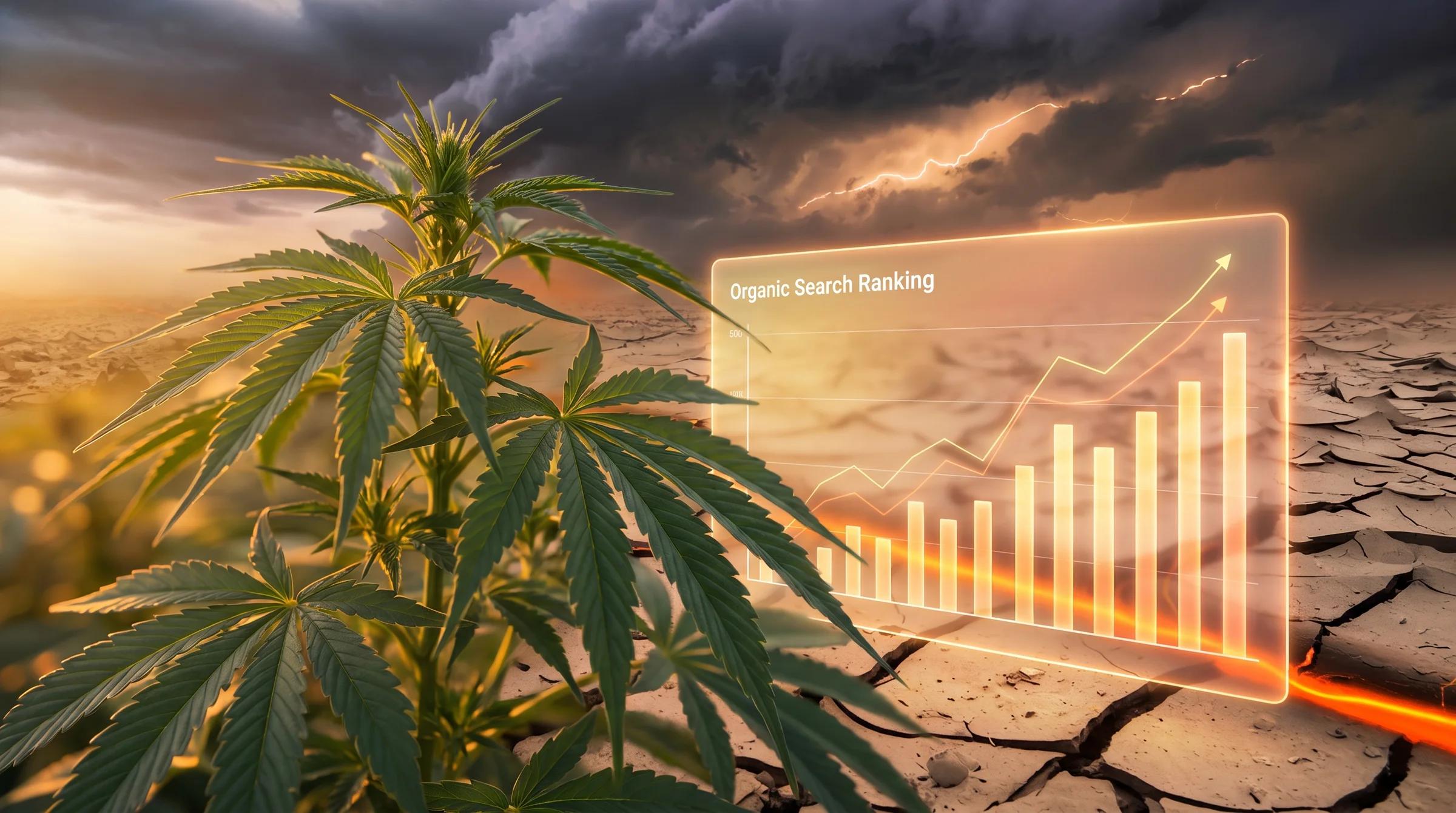
- Real CBD brands grew organic search traffic between 534% and 1,276% within 12 to 18 months using the same core playbook: fix technical issues first, eliminate keyword cannibalization, build topical authority through content clusters, then earn backlinks from niche-relevant domains.
- The global CBD market reached $20.49 billion in 2026 and is projected to reach $22.05 billion by 2030 growing at 15.8% CAGR, meaning the window to dominate organic search before competition intensifies further is closing fast.
- There is a critical gap in every CBD SEO result nobody discusses: Google’s AI Overviews apply a double YMYL filter to cannabis content, and organic CTR for AI-triggered queries dropped by up to 61%, meaning traffic gains can quietly evaporate even as rankings hold steady.
- Ahrefs’ February 2026 data shows AI Overviews now appear on 48% of queries, up from 34.5% in December 2025. For CBD brands specifically, AI safety filters add an extra layer that blocks citations even for page-one content.
The Result You Actually Want to See First
Four thousand, seven hundred and thirty monthly clicks. That is where one CBD brand started when they brought in a dedicated SEO team in early 2024. Twelve months later: 30,001 monthly clicks and organic revenue nearly doubled.
That is a 534% increase in organic traffic documented by Inbound Pursuit. First-page rankings for “THC gummies online” and “CBD sleep tincture.” Built without a single paid ad.
A second brand grew from 850 visitors per month to over 5,500 in 18 months, a 557% traffic jump. A third went from 2,000 to 20,000 monthly visitors in 12 months. And NP Digital’s CBD client ranked for 8,970 keywords with a 1,245% increase in organic traffic inside a single year. Braveheart Digital Marketing’s 2026 cannabis case study reported 1,276% organic traffic growth using refined content and link-building strategies.
These are not unicorns. They are the outcome of a specific process applied consistently in one of the hardest verticals to rank in.
Why CBD Is the Ultimate SEO Stress Test
If you can build a ranking CBD site, you can build rankings in almost any niche. This vertical throws every obstacle at you simultaneously.
Google Ads restricts CBD promotions to near-uselessness for most brands. Social media platforms enforce restrictions inconsistently. Instagram has banned accounts. Google has suppressed them. The playbook everyone else uses, paid acquisition and retargeting, is essentially locked.
But the ad ban is also a moat.
Because most brands cannot buy their way to visibility, the ones who invest in organic search build a durable competitive advantage. Once you own page one for “CBD gummies for sleep,” that position compounds. Competitors cannot outbid you. They have to outrank you, and that takes time.
E-E-A-T is not optional here. CBD falls squarely into YMYL territory because it affects health and wellness decisions. Google holds YMYL content to a measurably higher standard. A CBD site with thin author bios and no citations from credible medical sources gets suppressed regardless of backlinks.
The Cannabis Marketing Playbook 2026 identifies three forces defining the space: the rise of AI search engines that bypass traditional Google rankings, growing user reliance on zero-click search results, and the compliance-content balance that determines what actually ranks.
The Real 3-Phase Timeline (Nobody Shows You This Part)
Every case study shows month one and month twelve. They do not show what happened in between.
What actually happens in CBD SEO follows a consistent 3-phase arc. If you do not know what Phase 2 looks like, you will quit right before the results arrive.
Phase 1: Foundation (Months 1–3). Technical audit, fix, repair. The brand that grew from 2k to 20k monthly visitors found 1,800+ crawl errors, 14 broken internal links, 59 broken backlinks, and product pages with no meta titles. Traffic barely moves. This is also where keyword cannibalization gets addressed, one of the most under-discussed problems in CBD.
CBD product taxonomies are inherently redundant. “CBD oil,” “CBD tincture,” and “CBD drops” often describe identical products. Three pages targeting variations of the same keyword split authority three ways. The fix is consolidation through 301 redirects and keyword clustering, mapping each target keyword to a single page and purpose.
Phase 2: The Plateau (Months 3–6). Content is published. Links are built. Rankings move slowly. This is where clients historically panic. It is not a sign the strategy is failing. It is Google’s trust-building process for YMYL sites at play. In every case study, teams published content consistently (5 to 30 posts per month) and built backlinks (12 to 15 per month from domains with real traffic) before any of it clicked.
Phase 3: Compounding (Months 6–12+). Something changes around month six. Rankings start moving in clusters. A blog post about “CBD vs THC gummies” pulls traffic to the product page it links to. Category pages get enough topical authority to crack page one. The machine starts feeding itself.
“SEO for THC and CBD brands is not about hacks or shortcuts. It is about executing the fundamentals consistently and aligning your site with what Google actually wants to rank.”
- Inbound Pursuit, Cannabis SEO Case Study
The Compliance Trap: When Safe Content Becomes Invisible Content
Here is a tension no CBD SEO guide discusses honestly.
Google wants YMYL content accurate, compliant, and credible. The FDA restricts health claims. So CBD brands write content that is as cautious as possible. No claims about treating anxiety. No references to pain relief. Just careful language.
The problem? Content so thoroughly scrubbed of specificity that it says nothing useful.
“May support relaxation” means nothing from an information-gain standpoint. A user searching “does CBD help with sleep anxiety” who lands on a page full of “may support” phrases bounces. Google notices. The page sinks.
The solution requires threading a specific needle:
- Use clinical language, not marketing language. Link to PubMed and NIH studies. Let the research make the claim. Your copy cites and contextualizes it without restating it as a health promise.
- Bring in real expertise. A page reviewed by a licensed pharmacist signals to both Google and your user that someone with credentials stood behind the content. E-E-A-T for cannabis brands now requires trust signals AI models recognize.
- Answer the real question, then add the disclaimer. Users ask specific questions. Answer them specifically. Then add compliance language. Do not let the disclaimer eat the answer.
Think of a pharmacist at the counter. They do not say “this pill may or may not support your wellness goals.” They tell you what the drug does, what the evidence says, and what to watch for. That is useful. That is what ranks.
Pro Tip: Add a “Medically Reviewed By” section to every health-adjacent blog post. Name the reviewer, list credentials, and link to their professional profile. This builds E-E-A-T signals at the author level, not just domain level.
The New Threat: AI Overviews Are Quietly Stealing CBD Traffic
You can do everything right. Fix technical issues. Earn good backlinks. Write compliant, E-E-A-T-optimized content. Rank on page one.
And still lose clicks you never see leaving.
AI Overviews now appear on 48% of all queries as of March 2026. The problem for CBD brands is specific and serious. AI systems apply YMYL safety filters to health and substance-related queries. Cannabis content goes through a “double filter”: once for YMYL health content, once for regulated substance content. Even when your site ranks page one, it may not appear inside the AI-generated answer.
MG Magazine’s cannabis SEO coverage confirms Google’s AI Overviews are specifically rewriting cannabis SEO rules. Pew Research data shows only 8% of users click traditional links when an AI summary appears versus 15% without one.
What do you do about it? Generative Engine Optimization (GEO).
GEO is structuring content to be cited inside AI-generated answers. For CBD brands that means:
- Write answers that are self-contained and citable. A 900-word FAQ about “THCV vs THCA” with clear H2 questions and direct 2 to 3 sentence answers is more likely to be cited than a long editorial piece.
- Add structured data including license information, age-gating protocols, and product review data. This signals compliance to LLM safety filters.
- Include verifiable third-party citations. AI models are significantly more likely to cite content that cites credible external sources.
- Strengthen branded search signals. NisonCo’s 2026 cannabis SEO guide emphasizes that queries containing known brand names carry higher click-through rates.
SEO gets the ranking. GEO makes that ranking generate actual clicks in 2026. [INTERNAL LINK: GEO strategy for regulated industries]
The Backlink Problem Specific to CBD
One of the biggest ranking drops in the 2k-to-20k case study was not caused by anything Google did. It was the brand’s own previous link-building strategy.
The site had accumulated backlinks with exact match anchor text at a rate Google flagged as manipulative. Too many inbound links saying “CBD oil” pointed at the CBD oil page. After Penguin logic was folded into Google’s core algorithm, this triggered suppression.
The distribution that worked:
- Exact match anchor text: capped at 1 to 5% of all backlinks
- Partial match and branded: the bulk of the profile
- Generic and naked URLs: rounding out the rest
The best sources for CBD backlinks are wellness publications, hemp industry associations, health-focused blogs, and regional news outlets. Every domain should have real organic traffic (minimum 500 visitors per month) and actual editorial standards. Spokes Digital’s 2026 cannabis SEO guide recommends 3 to 6 months of consistent effort before ranking improvements become visible.
Frequently Asked Questions About CBD SEO
How long does CBD SEO take to show results?
Most CBD SEO campaigns show measurable ranking movement between months 3 and 6, with significant traffic growth between months 6 and 12. The delay is a function of Google’s trust-building process for YMYL sites. Brands with serious technical issues often see a longer Phase 1.
Can CBD brands rank on Google without paid ads?
Yes. Organic search is the most reliable long-term growth channel for CBD companies because paid advertising restrictions force competitors away from it. Every case study referenced achieved significant ranking and revenue growth through organic SEO alone.
What is GEO and does it matter for CBD brands?
GEO (Generative Engine Optimization) structures content to be cited inside AI-generated answers. For CBD brands, GEO matters because Google’s AI applies additional safety filters to regulated health content. CBD sites can rank page one without appearing in AI answers at all. Winning at GEO requires structured Q&A content, clear schema, verified citations, and strong branded search signals.
Why is keyword cannibalization especially bad for CBD sites?
CBD product catalogs have naturally overlapping product names. “CBD oil,” “CBD tincture,” and “CBD drops” often describe identical products, creating situations where multiple pages compete for the same query. The fix is a content audit mapping each keyword cluster to exactly one URL, consolidating duplicates via 301 redirects.
How many backlinks does a CBD site need to rank?
Quality and relevance matter more than raw count. The Inbound Pursuit campaign built 15 high-quality backlinks per month from wellness, cannabis, and health domains with domain ratings above 30 and real organic traffic. That pace applied over 12 months moved a brand from page 3 to page 1 for competitive transactional keywords.
What This Actually Means for Your CBD Brand
The results are real. The process is repeatable. But the game is getting harder.
Getting to page one in 2024 required solid technical SEO, strong content clusters, and consistent link building. That is still true. But holding those rankings and converting them into clicks now requires building content structures that survive AI filtering, earn citations inside AI Overviews, and carry enough branded authority that both search algorithms and AI models treat you as a source worth referencing.
The brands dominating CBD search in 2026 are not just thinking about keywords and backlinks. They are thinking about how their content reads to a language model deciding whether to cite it or suppress it.
If you want a team that understands both SEO fundamentals and GEO, LoudScale works with brands in regulated verticals who need organic growth they can keep.
- Website Growth GraderFlagship free growth grade score before email.
- SEO Checker40+ live HTML checks on any public URL.
- AI Visibility ReadinessAnswer-engine readiness and extractability.
Diagnostics show a useful score before email. Explore LoudScale services when you want a full plan and implementation.
LoudScale Team
Growth Marketing Specialists
The LoudScale team shares practical strategies and experiments across search and AI visibility, content authority, B2B lead generation, lifecycle systems, analytics, and responsible AI.