TL;DR
- AI Overviews now slash position-one CTR by 58% according to Ahrefs’ December 2025 data, up from 34.5% in April 2025. If you’re only tracking rankings, you’re reading last decade’s story.
- 84% of B2B SaaS CMOs now use ChatGPT, Claude, or Perplexity for vendor discovery (Wynter, January 2026). 68% start with AI tools before they touch Google. If B2B is your market, AI invisibility is a pipeline problem.
- AI search traffic grew 527% year-over-year, but it’s still just 1–2% of total site traffic for most businesses. The volume is tiny. The value is massive: the average AI-referred visitor converts at 4.4x the rate of a traditional organic visitor.
- The SEO-AEO-GEO framework below tells you exactly where to spend your time based on your business model. Spreading effort equally across all three is the fastest way to spin your wheels.
Let me tell you about the worst piece of advice I got in 2025. A consultant I respect told me to build an entirely separate content workflow for “generative engine optimization.” New briefs. New formats. New KPIs. I spent two weeks restructuring a client’s entire blog before realizing something: I was fixing problems that didn’t exist and ignoring the one that did.
Here’s what the data actually says six months later. Roughly 80% of what gets branded “AI SEO” is traditional SEO with a new acrylic nameplate. The other 20% is genuinely novel - and that 20% matters enormously if you’re in the right kind of business. This guide separates the signal from the noise so you don’t burn Q3 reinventing things that have been working since 2019.
Why the AI SEO Panic Is Mostly Misdirected
Google’s Danny Sullivan said it plainly at WordCamp US in August 2025: “Good SEO is good GEO.” He wasn’t minimizing the change. He was explaining the architecture.
Retrieval-augmented generation (RAG) is the technical process that powers every AI answer engine you care about: Google AI Overviews, ChatGPT’s web search, Perplexity, and Claude. These systems don’t build their own indexes. They search the web through existing search infrastructure - Google, Bing - retrieve sources, and synthesize answers from what they find. If your pages don’t rank in the top 10–20 organically, RAG-based systems probably can’t find you.
The data makes this brutally clear. Ahrefs analyzed thousands of AI Overview results in 2025 and found 76% of cited pages already ranked in Google’s top 10 organic positions. SeoClarity found a similar pattern: 97% of AI Overviews cite at least one page from the top 20 organic results. This isn’t coincidence. It’s the retrieval pipeline doing exactly what it was designed to do.
Lily Ray, VP of SEO Strategy at Amsive, tested this directly. In her MozCon 2025 presentation, she demonstrated that articles built with standard SEO best practices - no “GEO hacks,” no chunking strategies - were cited by multiple AI platforms within hours of publication. The content that wins citations is the same content that wins featured snippets and organic rankings: clear definitions, self-contained answers, named sources.
“The tactics to earn AI search visibility are really just evolutions of existing SEO and marketing best practices.”
- Lily Ray, VP of SEO Strategy and Research at Amsive
So why is the consulting industry treating GEO like it requires a separate team and budget? Partially because new acronyms sell retainers. Partially because the measurement layer genuinely is new (we’ll get there). But mostly because people conflate new surfaces with new fundamentals.
Think about it like this: when Instagram added shopping features, nobody declared the birth of “Instagram Commerce Optimization.” You adapted your product pages. You adjusted your distribution. You didn’t reinvent ecommerce. Same deal here.
The Metrics That Actually Changed in 2026
Traditional SEO metrics aren’t obsolete. They’re incomplete. Here are four numbers that tell the 2026 story.
1. CTR is cratering - but recovering slightly
Ahrefs’ February 2026 update found AI Overviews now reduce position-one organic click-through rate by 58%, up from 34.5% in April 2025. For every 100 clicks you historically earned from a #1 ranking, Google now keeps 58.
Seer Interactive’s April 2026 study of 53 brands and 5.47 million queries found a more nuanced picture. The organic CTR for queries with AI Overviews bottomed out at 1.3% in December 2025 before climbing to 2.4% by February 2026. Still a fraction of the 3.3% CTR on searches without AI Overviews, but directionally interesting.
The breakdown matters: pages cited inside AI Overviews saw roughly 2.1% CTR. Pages not cited? 0.9%. Being named in the answer is worth roughly 2.3x the clicks of being invisible within it.
The stat that should wake you up: AI Overviews now appear on roughly 36% of informational searches, 86% of question-format queries, and 95% of comparison searches (Seer Interactive, April 2026).
2. Zero-click is now the majority experience
The Bain & Company 2025 zero-click search study found roughly 60% of traditional search engine searches now end without a click. When AI summaries appear specifically, Pew Research found only 8% of users click a traditional link versus 15% without a summary.
Google’s own data from May 2026 confirms the acceleration. AI Mode surpassed 1 billion monthly active users globally, with queries more than doubling every quarter since launch. The average AI Mode query is triple the length of a traditional search query. Users are having conversations, not running searches.
3. AI traffic is small but terrifyingly efficient
Total AI-referred traffic still accounts for roughly 1–2% of site visits for most businesses. But the growth curve is vertical: Semrush’s clickstream analysis found ChatGPT referral traffic grew 206% in 2025 alone. The Previsible AI Traffic Report tracked 527% year-over-year growth in LLM referral sessions across 19 properties.
And AI-referred visitors convert at 4.4x the rate of traditional organic visitors, according to Semrush’s 2025 AI search traffic study. Smaller volume. Far higher intent. These are people who got the overview from ChatGPT, decided they wanted depth, and clicked through to your site specifically.
4. The B2B buyer journey starts in AI now
Wynter’s January 2026 survey of 101 mid-market B2B SaaS CMOs found 84% now use AI tools for vendor discovery, up from 24% in 2025 and zero in 2024. 68% start their software searches in ChatGPT, Claude, or Perplexity before ever typing a query into Google. LLM recommendations now rank as the #4 consideration factor - ahead of Google research, supplier content, supplier ads, and cold outreach.
If you sell to other businesses and your brand doesn’t appear when someone asks ChatGPT “what’s the best [your category] tool?”, you may never enter the consideration set at all. 80% of CMOs now arrive at sales calls moderately familiar with the vendor. 48% arrive “very familiar” - up from 22% in 2025.
The SEO-AEO-GEO Prioritization Framework
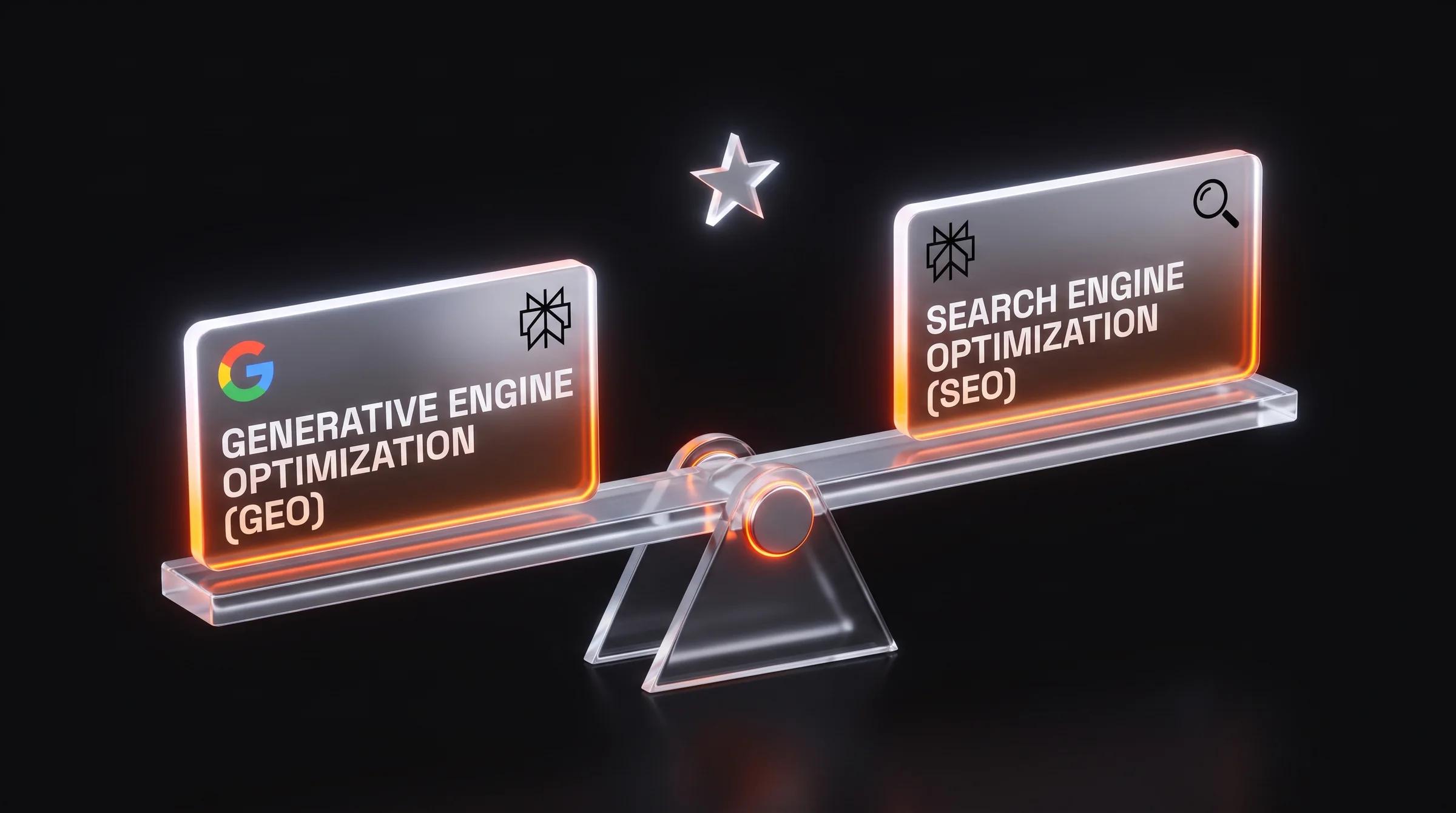
Most teams I talk to treat SEO, AEO, and GEO as three separate strategies requiring three separate workstreams. That’s a mistake. These are layers of the same game, and the sequence you attack them in decides whether you get results or committee meetings.
SEO (Search Engine Optimization): Your content ranking in Google’s traditional organic results. This is the foundation. Nothing above it works without it.
AEO (Answer Engine Optimization): Your content being cited as a specific source by AI platforms like ChatGPT, Perplexity, and Google AI Overviews. AEO happens when your SEO is strong enough that RAG systems retrieve your pages.
GEO (Generative Engine Optimization): Your brand being named, recommended, and described accurately inside AI-generated answers - even when your specific URL isn’t linked. This is the brand-reputation layer.
Here’s the prioritization logic:
- Fix SEO first. If your pages don’t rank in the top 10–20 organically, AI retrieval systems likely can’t find you. Remember: 76% of citations pull from top-10 organic results. Technical health, content quality, and backlinks are your entry ticket.
- Structure for AEO second. Once you rank, make your content extractable. Self-contained answers under clear headings. Definitions in first sentences. Statistics with named sources and dates. This isn’t new - it’s the same playbook that wins featured snippets.
- Build GEO through authority third. Get mentioned on Wikipedia, Reddit, YouTube, and reputable industry publications. Earn coverage from outlets AI systems trust. This has always been digital PR. It now has dual purpose.
Before you spend a dollar on GEO tools, do this: type your 10 most important buyer queries into ChatGPT, Perplexity, and Google AI Mode. If competitors show up and you don’t, check whether you rank for those same queries in traditional Google first. In nearly every case I’ve debugged, the AI visibility gap was actually a ranking gap in costume.
Which layer matters most for your business?
| Business Type | SEO Priority | AEO Priority | GEO Priority | The logic |
|---|---|---|---|---|
| B2B SaaS ($10M+ ARR) | High | High | Very High | 84% of CMOs now start vendor searches in AI. If you’re not named, you’re not in the deal. |
| Local service business | Very High | Medium | Low | AI Overviews appear infrequently on “near me” queries. Google Business Profile still dominates. |
| E-commerce (DTC) | Very High | Medium | Medium | Product pages need organic rankings. AI shopping integrations are accelerating but still nascent. |
| Content / media publisher | High | Very High | Medium | 88% of AI Overview triggers are informational. Your content IS the answer. Being cited is existential. |
| Solo consultant / agency | Medium | Medium | High | Buyers ask AI “who’s the best [specialty] consultant?” Your name needs to be in that output. |
How to Actually Get Cited by AI Answer Engines
Here’s where the “AI SEO” hype cycle has done real damage. People obsess over formatting content into rigid Q&A chunks. They restructure entire sites around “AI chunking.” Lily Ray addressed this directly at MozCon: AI models don’t see your formatting. They see tokens. They decide how to carve up your content, not you.
What you can control is clarity and citability. After reviewing hundreds of AI-generated responses across ChatGPT, Perplexity, and Google AI Mode, here are the patterns that separate cited content from ignored content:
- Answer-first writing. Every H2/H3 section opens with 1–3 sentences that directly answer the implied question. AI engines extract standalone passages - they’re not reading your introduction for context.
- Named entities and specific data. “Revenue grew 40%” gets skipped. “Company Corp’s revenue grew 40% in Q3 2025 according to their public earnings report” gets cited. Specificity is a credibility heuristic.
- Source-rich claims. Every statistic paired with who reported it and when. RAG systems prefer claims that arrive with built-in attribution markers because they can verify the claim against the named source.
- Definitions at point of entry. When you introduce a concept, define it in the same sentence. AI engines love extracting the sentence that follows “X is…” because it cleanly resolves the user’s informational query.
These sound exactly like the featured-snippet best practices the industry has been teaching since 2017, because they are. The SEO playbook already contains 80% of what AI answer engines reward. The remaining 20% is distribution - showing up on platforms where AI models pull their citations.
A 2026 addition worth knowing: Google added an llms.txt check to Chrome Lighthouse in May 2026. Nick Fox, Google’s head of Search, said at I/O 2026 that AI search rewards content that “goes deeper.” The signal is consistent: surface-level content won’t cut it for AI citations. Domain depth, original research, and proprietary data are the new table stakes.
What I’ve Stopped Tracking and What I’ve Added
My measurement framework looked very different 18 months ago. Here’s what changed.
Metrics I’ve added:
- AI Share of Voice. How often does your brand appear in AI-generated answers versus competitors? Semrush’s AI Visibility Toolkit, Profound, and Peak AI now track this. Think of it as the new SERP ranking report.
- AI-Referred Traffic and Conversions. Set up a custom channel in GA4 grouping referrer domains from ChatGPT, Perplexity, Claude, and Gemini. Volume will look trivial. The conversion rate won’t.
- Branded search lift. When AI tools recommend your brand, users often navigate to your site directly or search your brand name in Google. Correlated lifts in branded search volume are the bridge metric between “we got mentioned in ChatGPT” and “it drove pipeline.”
Metrics I’ve stopped obsessing over:
- Raw organic click volume in isolation. Fighting the CTR trend is like arguing with the tide. Seer Interactive’s data shows searches without AI Overviews are actually growing in value - CTR on those queries rose from 2.8% to 3.8% between early 2025 and February 2026. Focus your effort where clicks still exist, and ensure your brand presence inside AI summaries does the awareness work that a click used to do.
The AI Content Reality Check
AI-generated content now accounts for over 17% of pages in Google’s top 20 search results according to Originality.ai’s latest tracking. Search Engine Land reported in May 2026 that nearly half of online articles are now AI-generated. Google hasn’t banned it. They’ve said quality and helpfulness are what counts, regardless of production method.
Here’s the uncomfortable nuance: the AI content that actually earns citations and rankings is almost never “prompt, generate, publish.” It’s AI-assisted content where a named human with real experience directs the structure, injects proprietary data, takes actual positions, and edits aggressively for accuracy. The gap between AI-written and AI-assisted is the gap between commodity noise and citability.
Why does this matter specifically for AI SEO? Because RAG systems prioritize content with clear E-E-A-T signals (Experience, Expertise, Authoritativeness, Trustworthiness). A purely AI-generated article with no author attribution, no original data, and no specific experience signals reads as background static to these systems. Content that cites original research, quotes named experts, and takes evidenced positions is exactly what retrieval engines want to surface.
The irony is sharp. To rank in AI search results, you have to produce content that clearly isn’t just AI output. You need the human fingerprints that models struggle to fake: lived domain experience, proprietary data, counter-consensus opinions, and the specific weird details that only come from doing the work.
Frequently Asked Questions
Is AI SEO really just traditional SEO rebranded?
Mostly. Ahrefs found 76% of AI Overview citations come from top-10 organic rankings. Google’s Danny Sullivan said “good SEO is good GEO” at WordCamp US 2025. The genuinely new layer is measurement - tracking how often your brand appears in AI answers, in what context, and whether those appearances drive business outcomes. The content fundamentals haven’t changed.
How much traffic do AI search platforms send?
For most sites, 1–2% of total traffic. ChatGPT referral traffic grew 206% in 2025 (Semrush clickstream data, April 2026). It’s growing fast from a small base. The conversion story matters more than the volume: AI-referred visitors convert at 4.4x the rate of traditional organic visitors.
Should I block AI crawlers?
Blocking AI crawlers removes you from every AI-powered discovery channel at once. Only about 11% of site owners completely block AI scrapers (AIOSEO, 2026). Unless you have a specific monetization reason - like a paywalled publisher - blocking costs you far more visibility than it protects.
What tools track AI visibility?
Semrush’s AI Visibility Toolkit, Profound, Peak AI, and Ahrefs are the established options. For a free manual check, enter your target queries into ChatGPT, Perplexity, and Google AI Mode and note whether your brand or URLs appear. Set up a custom “AI Search” channel in GA4 to group LLM referral traffic for long-term monitoring.
Do I need separate content for AI search?
No. The same content that ranks well on Google - authoritative, well-structured, factually grounded, with clear answers to specific questions - is what AI systems retrieve and cite. The main adjustment: make every important claim self-contained so it makes sense when extracted in isolation. AI engines pull passages, not pages.
There’s a version of AI SEO that’s genuinely worth your energy. It’s the version where you keep doing excellent traditional SEO, layer AI visibility tracking on top of your existing measurement stack, and make deliberate moves to get your brand mentioned across the surfaces AI systems scrape. No secret rituals. No new acronym taxonomies.
[INTERNAL LINK: SEO strategy framework for 2026]
But start with the framework above. Fix what’s broken in your traditional SEO. Audit your AI visibility on the 10 queries that actually drive revenue. Then decide where the gaps are before you invest in anything with a shiny name. The sequence matters more than the tactics.
[INTERNAL LINK: How to measure organic search ROI]
If you’d rather have a team handle the integrated strategy across all three layers, LoudScale works with growth-stage companies on exactly this: traditional SEO, AI answer engine visibility, and brand presence across every surface that drives pipeline.
[INTERNAL LINK: B2B content strategy guide]
Sources
- Ahrefs: AI Overviews Reduce Clicks by 58% (February 2026)
- Ahrefs: Search Rankings and AI Citations (July 2025)
- Semrush: 26 AI SEO Statistics for 2026 (November 2025)
- Semrush: ChatGPT Traffic Analysis - 17 Months of Clickstream Data (April 2026)
- Semrush: AI Search SEO Traffic Study (2025)
- Wynter: How B2B SaaS CMOs Buy Software in 2026 (January 2026)
- Search Engine Land: Google AI Overviews CTR Shows Early Signs of Recovery (April 2026)
- Google Blog: How AI Mode Is Changing Search in the U.S. (May 2026)
- Search Engine Land: Google’s Nick Fox - AI Search Rewards Deeper Content (May 2026)
- Pew Research: Google Users Less Likely to Click Links When AI Summaries Appear (July 2025)
- SeoClarity: AI Overviews Impact Research (2025)
- Bain & Company: Goodbye Clicks, Hello AI - Zero-Click Search Redefines Marketing (2025)
- Originality.ai: AI Content in Google Search Results (2025)
- AI Visibility ReadinessScore AI Visibility Readiness (not live mentions) free.
- SEO CheckerLive on-page extractability, schema, and trust checks.
- Website Growth GraderFull growth diagnostic across SEO and positioning.
Diagnostics show a useful score before email. Explore LoudScale services when you want a full plan and implementation.

LoudScale Team
Growth Marketing Specialists
The LoudScale team shares practical strategies and experiments across search and AI visibility, content authority, B2B lead generation, lifecycle systems, analytics, and responsible AI.